Introduction
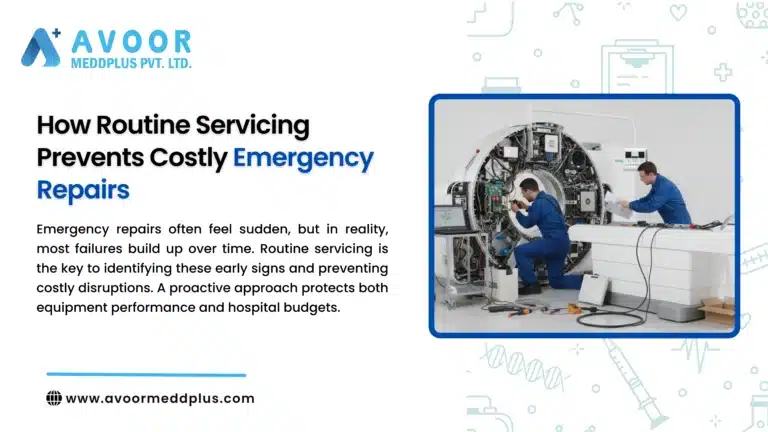
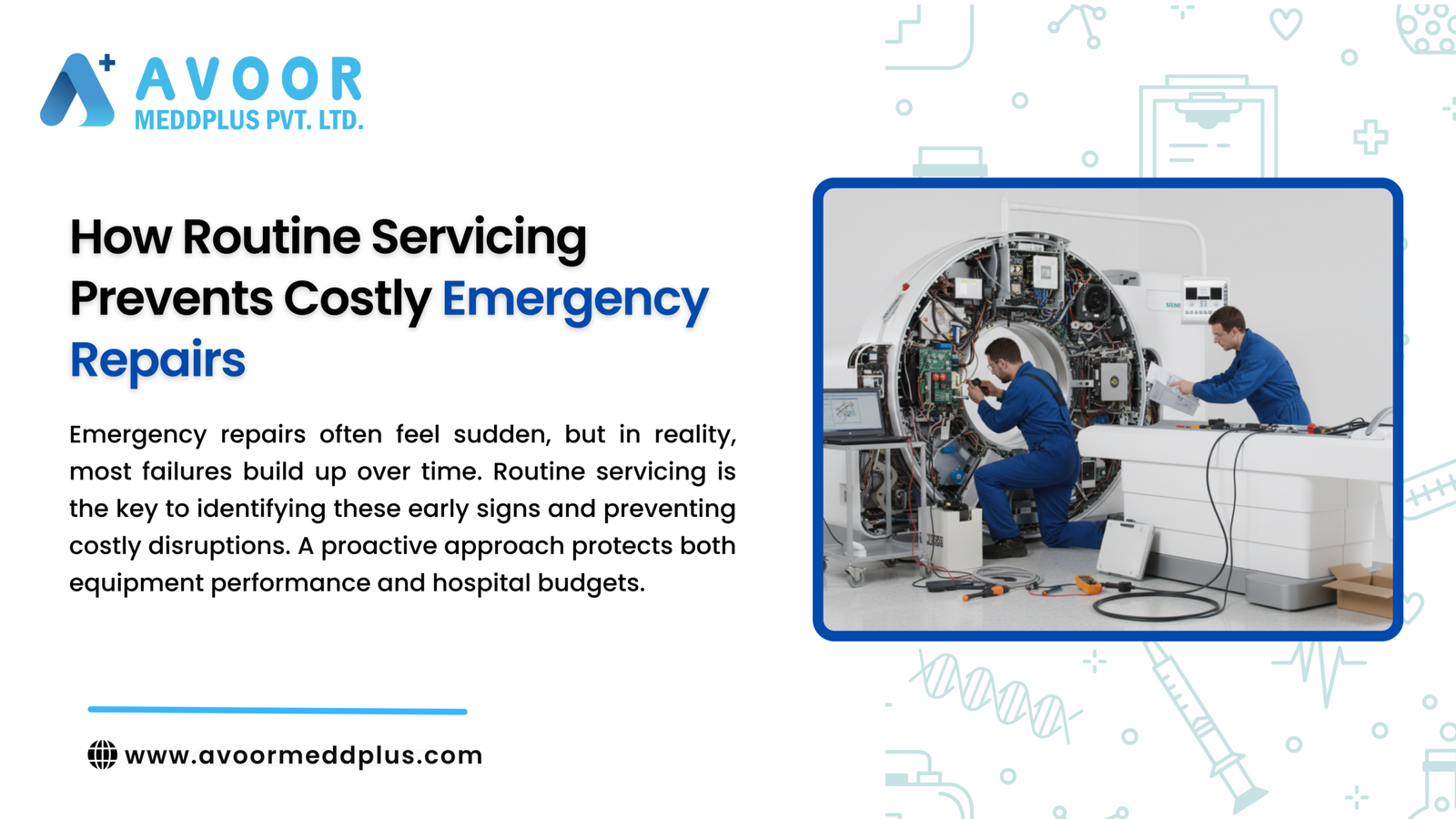
Medical equipment plays a critical role in ensuring accurate diagnosis, efficient workflows, and patient safety in hospitals and diagnostic centers. Systems like CT, PET/CT, DR, C-ARM, and other biomedical devices operate continuously under demanding conditions. While emergency repairs may seem sudden, most equipment failures actually develop gradually over time.
This is why routine servicing prevents costly emergency repairs by identifying early warning signs and addressing them before they escalate. A proactive maintenance approach ensures consistent performance, reduces downtime, and protects hospital budgets. At Avoor Meddplus Pvt Ltd, routine servicing is a key part of structured maintenance programs designed to enhance reliability and minimize operational risks.
1. Understanding Equipment Failures in Healthcare
Medical equipment does not usually fail without warning. Most failures are caused by:
- Component wear and tear
- Overheating and cooling inefficiencies
- Calibration drift
- Electrical instability
- Software issues
- Lack of timely maintenance
When these issues are ignored, they gradually worsen and eventually lead to unexpected breakdowns. Routine servicing prevents costly emergency repairs by addressing these problems at an early stage.
2. What Is Routine Servicing?
Routine servicing refers to scheduled maintenance activities performed at regular intervals to ensure equipment operates within optimal parameters.
It typically includes:
- Preventive inspections
- Calibration and validation
- Cleaning and component checks
- Electrical safety testing
- Performance monitoring
- Minor adjustments and repairs
Unlike reactive maintenance, routine servicing focuses on prevention rather than correction.
3. 7 Key Ways Routine Servicing Prevents Costly Emergency Repairs
1️⃣ Early Detection of Hidden Issues
Routine servicing helps identify minor faults such as:
- Loose connections
- Temperature irregularities
- Minor image artifacts
- Voltage fluctuations
Addressing these early prevents major system failures.
2️⃣ Prevents Sudden Equipment Breakdown
Emergency repairs often occur due to neglected maintenance. Routine servicing ensures:
- Components are inspected regularly
- Potential failures are identified in advance
- Systems remain stable during operation
This significantly reduces unexpected downtime.
3️⃣ Maintains Calibration and Accuracy
Imaging systems require precise calibration for accurate diagnostics. Routine servicing includes:
- Radiation output verification
- Detector alignment checks
- Image quality validation
Maintaining calibration prevents diagnostic errors and repeat scans.
4️⃣ Reduces Repair Costs
Emergency repairs are expensive due to:
- Urgent spare part requirements
- Extended downtime
- Higher labor costs
Routine servicing minimizes these expenses by preventing major failures and reducing repair complexity.
5️⃣ Extends Equipment Lifespan
Regular servicing reduces stress on critical components such as:
- Tubes and detectors
- Power supply units
- Cooling systems
This extends the operational life of high-value medical equipment and improves return on investment.
6️⃣ Improves Workflow Stability
Equipment breakdowns disrupt patient schedules and clinical workflows. Routine servicing ensures:
- Consistent system performance
- Fewer interruptions
- Predictable maintenance schedules
Stable workflows enhance overall hospital efficiency.
7️⃣ Ensures Safety and Compliance
Routine servicing includes safety checks that ensure:
- Electrical safety compliance
- Radiation dose accuracy
- Proper documentation for audits
Compliance reduces legal and operational risks.
4. Routine Servicing Across Imaging Modalities
CT & PET/CT Systems
- Gantry alignment checks
- Detector calibration
- Tube and cooling system inspection
- Dose accuracy validation
DR & CR Systems
- Flat-panel detector testing
- Exposure consistency checks
- Image uniformity validation
C-ARM Systems
- Fluoroscopy output verification
- Radiation safety checks
- Mechanical inspection
SPECT/CT & Nuclear Medicine
- Energy peaking
- Uniformity correction
- Fusion alignment accuracy
Each system benefits from routine servicing tailored to its operational needs.
5. Routine Servicing vs Emergency Repairs
| Aspect | Routine Servicing | Emergency Repairs |
|---|---|---|
| Approach | Preventive | Reactive |
| Cost | Predictable | High and sudden |
| Downtime | Minimal | Extended |
| Risk | Low | High |
| Equipment Life | Extended | Reduced |
This comparison highlights why routine servicing prevents costly emergency repairs more effectively than reactive approaches.
6. Role of Skilled Biomedical Engineers
Routine servicing requires expertise and precision. Certified biomedical engineers:
- Identify early warning signs
- Perform accurate calibration
- Ensure safety compliance
- Maintain service documentation
- Provide reliable technical support
Professional expertise ensures servicing delivers real performance improvements.
7. Financial and Operational Benefits
Hospitals that invest in routine servicing experience:
- Reduced emergency repair costs
- Lower downtime-related revenue loss
- Improved maintenance planning
- Better equipment utilization
- Enhanced patient satisfaction
Routine servicing transforms maintenance into a strategic cost-saving measure.
8. How Avoor Meddplus Pvt Ltd Supports Preventive Servicing
Avoor Meddplus Pvt Ltd delivers reliable routine servicing through:
- Structured preventive maintenance programs
- OEM-grade calibration and validation
- PCB-level repair expertise
- Early fault detection
- Compliance-ready documentation
- Fast-response technical support
- Nationwide service coverage
This proactive approach ensures equipment remains reliable, safe, and performance-driven.
Conclusion
Equipment failures are rarely sudden they are often the result of issues that went unnoticed over time. Routine servicing prevents costly emergency repairs by detecting problems early, maintaining calibration, and ensuring consistent performance.
Hospitals that adopt routine servicing strategies reduce operational risks, control costs, and improve patient care outcomes. With expert support from Avoor Meddplus Pvt Ltd, routine servicing becomes a powerful tool for maintaining reliable, efficient, and compliant healthcare operations.