
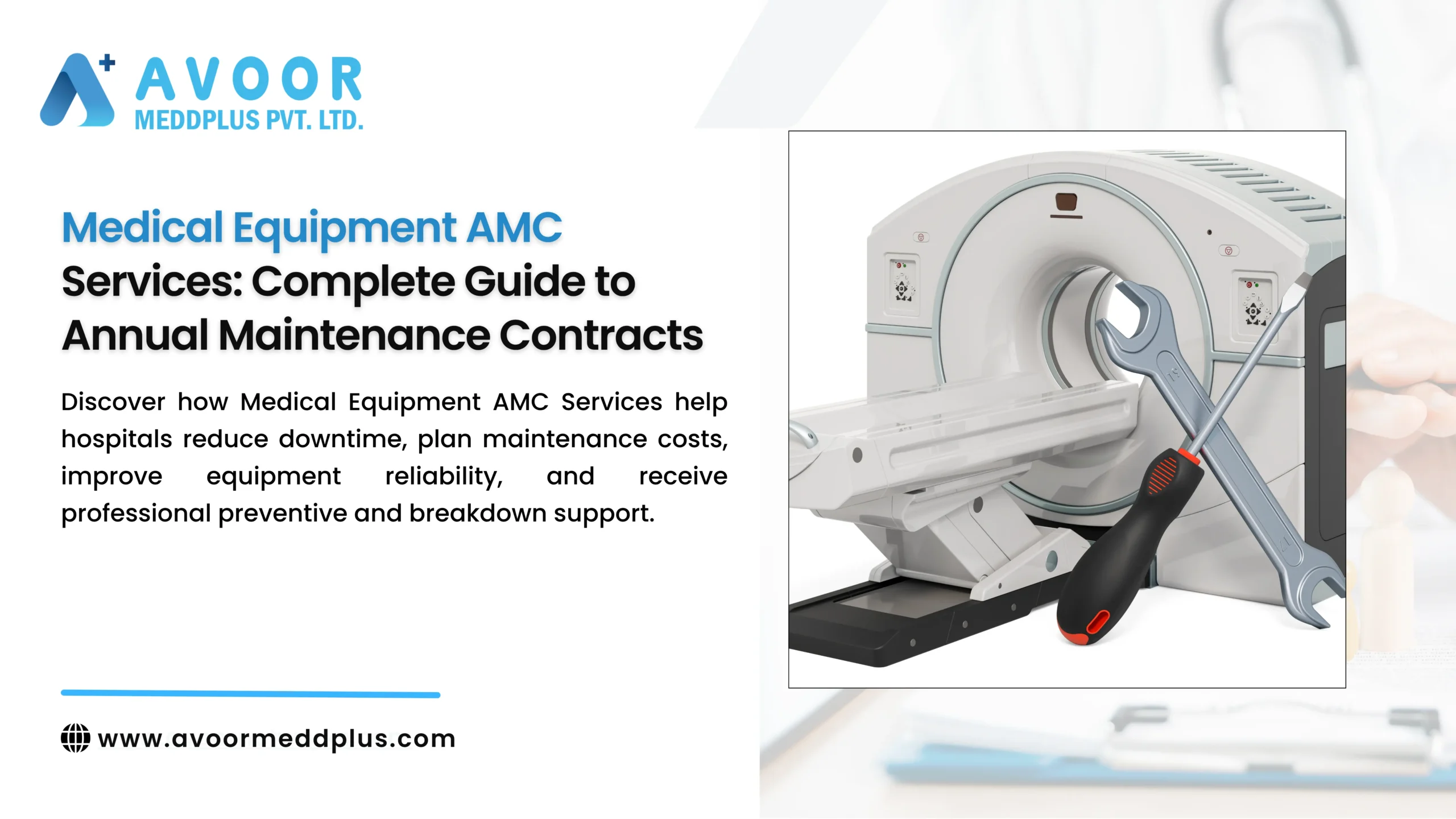
Medical Equipment AMC Services are an important part of maintaining reliable healthcare infrastructure.
Hospitals, diagnostic centers, clinics, laboratories, and healthcare facilities depend on medical equipment every day. Equipment such as CT scanners, MRI systems, ultrasound machines, X-ray systems, patient monitors, laboratory analyzers, ventilators, and other critical devices must remain available and operational.
Unexpected equipment failure can lead to appointment delays, cancelled procedures, reduced diagnostic capacity, higher repair costs, and disruption to patient care.
A well-structured Medical Equipment AMC Services program provides a planned approach to equipment maintenance, inspection, troubleshooting, and repair.
Instead of waiting for equipment to fail, healthcare organizations can use preventive maintenance and scheduled technical support to identify potential problems earlier.
This complete guide explains what a medical equipment AMC is, what it can include, its benefits, common contract types, important terms to review, and how hospitals can select the right service provider.
What Are Medical Equipment AMC Services?
Medical Equipment AMC Services are annual service agreements between a healthcare organization and a technical service provider for maintaining specified medical equipment.
AMC stands for Annual Maintenance Contract.
Depending on the agreement, an AMC may include:
- Preventive maintenance
- Scheduled inspections
- Breakdown support
- Equipment diagnostics
- Technical service visits
- Performance checks
- Component replacement
- Repair support
- Service documentation
The exact coverage depends on the contract.
Some agreements cover only labor and preventive maintenance, while others may include spare parts and comprehensive repair coverage.
Therefore, hospitals should carefully review the scope before signing an AMC.
Why Medical Equipment AMC Is Important
Medical equipment is often used in demanding environments.
Equipment may operate for extended periods and can be affected by:
- Continuous usage
- Electrical fluctuations
- Temperature
- Dust
- Humidity
- Component aging
- Mechanical wear
- Software or firmware issues
Without planned maintenance, small problems may develop into larger failures.
A structured AMC program can help healthcare facilities move from a purely reactive maintenance model toward a more proactive approach.
What Does a Medical Equipment AMC Include?
The scope varies between service providers and equipment categories.
A typical AMC may include the following.
Preventive Maintenance
Scheduled inspections are performed to identify potential problems.
Activities may include:
- Visual inspection
- Cleaning
- Electrical checks
- Mechanical inspection
- Cooling-system checks
- Performance verification
- Error-log review
Breakdown Maintenance
When equipment stops working, the service provider investigates the failure and performs appropriate corrective action.
Technical Support
Technical assistance may be provided through:
- Phone support
- Remote troubleshooting
- Engineer visits
- On-site diagnostics
Service Documentation
A professional AMC should maintain records of:
- Service dates
- Equipment condition
- Faults identified
- Repairs performed
- Parts replaced
- Recommendations
10 Benefits of Medical Equipment AMC Services
1. Reduced Equipment Downtime
Equipment downtime can have a direct impact on healthcare operations.
A CT scanner, MRI system, ultrasound machine, or laboratory analyzer that is unavailable can affect scheduled patients and clinical workflows.
Regular maintenance can help identify certain problems before they result in major failures.
2. Predictable Maintenance Costs
Unexpected breakdowns can result in significant expenses.
AMC agreements can make maintenance expenditure more predictable.
Depending on the contract, the organization may have defined:
- Service charges
- Preventive maintenance visits
- Response times
- Labor coverage
- Spare-parts terms
This can make annual maintenance budgeting easier.
3. Extended Equipment Life
Proper maintenance can help medical equipment operate reliably throughout its useful service life.
Regular inspection can identify:
- Component degradation
- Cooling problems
- Electrical issues
- Mechanical wear
- Performance abnormalities
Early intervention may prevent certain minor problems from becoming major failures.
4. Better Equipment Reliability
Healthcare professionals depend on equipment being available when needed.
A preventive maintenance program can improve operational reliability by establishing regular technical checks.
This is especially important for equipment used frequently or equipment that plays an important role in diagnostic or treatment workflows.
5. Faster Breakdown Response
A defined AMC can establish procedures for responding to equipment failures.
The contract should clearly specify:
- Response time
- Service availability
- Escalation process
- Engineer availability
- Emergency support
Clear service-level expectations can help healthcare organizations respond more efficiently to breakdowns.
6. Better Maintenance Planning
An AMC creates a structured maintenance schedule.
Hospitals can plan preventive maintenance around:
- Patient schedules
- Equipment workload
- Department availability
- Clinical operations
This is preferable to discovering a maintenance requirement only after equipment fails.
7. Access to Technical Expertise
Medical equipment can contain sophisticated electronic, mechanical, software, and imaging systems.
Professional service providers can provide specialized technical knowledge for equipment diagnosis and maintenance.
Depending on their capabilities, service providers may also support:
- PCB diagnostics
- Electronic repair
- Power-supply repair
- Component-level repair
- Cooling-system maintenance
8. Improved Service Documentation
Proper documentation is an important part of equipment lifecycle management.
AMC records can help hospitals track:
- Equipment history
- Failure frequency
- Repair costs
- Parts replaced
- Preventive maintenance
- Downtime
This information can support future repair, replacement, and budgeting decisions.
9. Better Lifecycle Management
An AMC can help organizations determine when equipment is becoming uneconomical to maintain.
For example, if an older system requires repeated repairs, increasing spare-part costs may indicate that replacement should be considered.
A maintenance history provides useful information for these decisions.
10. Greater Operational Confidence
Reliable equipment supports smoother healthcare operations.
While an AMC cannot eliminate all failures, a well-designed maintenance program can reduce avoidable risks and provide a defined technical support process when problems occur.
Preventive Maintenance Under an AMC
Preventive maintenance is one of the most important elements of an AMC.
The exact procedure depends on the equipment.
For example, maintenance of an imaging system may involve different checks from maintenance of a laboratory analyzer.
A preventive maintenance visit may include:
Physical Inspection
- Equipment condition
- Cables
- Connectors
- Cooling
- Mechanical components
Electrical Inspection
- Power supply
- Voltage
- Connections
- Electrical safety-related checks where applicable
Performance Checks
- System operation
- Error conditions
- Relevant functional parameters
Environmental Checks
- Temperature
- Humidity
- Ventilation
- Equipment surroundings
Documentation
Every service visit should be documented appropriately.
Breakdown and Corrective Maintenance
Preventive maintenance reduces risk, but equipment can still fail.
Corrective maintenance begins when a problem occurs.
A structured troubleshooting process should identify whether the problem is related to:
Power → Electronics → Hardware → Cooling → Software → Configuration → Environment
The technician should identify the root cause rather than simply replacing components without diagnosis.
Medical Imaging Equipment AMC
Medical imaging equipment often requires specialized technical support.
Depending on the service provider’s expertise, AMC coverage may include equipment such as:
- CT scanners
- MRI systems
- PET/CT systems
- SPECT/CT systems
- X-ray systems
- Ultrasound systems
- C-arm systems
- Mammography systems
Maintenance requirements vary considerably between these systems.
For example, CT systems may require attention to cooling, power systems, electronics, and mechanical components.
MRI systems have specialized technical and environmental requirements.
Therefore, hospitals should verify that an AMC provider has relevant experience with the specific equipment category.
Diagnostic Equipment AMC
Diagnostic departments may also rely on:
- Patient monitors
- ECG systems
- Laboratory analyzers
- Imaging systems
- Blood analyzers
- Monitoring equipment
- Specialized diagnostic devices
A service contract should clearly identify exactly which equipment is covered.
What Equipment Can Be Covered?
A hospital AMC may cover one device or an entire equipment category.
Examples include:
Imaging
- CT
- MRI
- PET/CT
- SPECT/CT
- X-ray
- Ultrasound
- C-arm
Patient Monitoring
- ECG
- Multiparameter monitors
- Pulse oximeters
- Other monitoring systems
Laboratory
- Biochemistry analyzers
- Hematology analyzers
- Immunoassay systems
- Specialized laboratory equipment
Other Medical Equipment
Coverage depends on the service provider’s technical capabilities and contract scope.
Comprehensive vs Non-Comprehensive AMC
Understanding the difference is extremely important.
Non-Comprehensive AMC
A non-comprehensive AMC generally covers service and preventive maintenance, while spare parts may be charged separately.
Potential advantages include:
- Lower annual contract cost
- Flexible parts purchasing
- Suitable for relatively reliable equipment
However, unexpected parts expenses can occur.
Comprehensive AMC
A comprehensive AMC may include:
- Preventive maintenance
- Breakdown service
- Labor
- Selected spare parts
Because coverage is broader, the annual contract price is generally higher.
Always Check the Exclusions
A comprehensive AMC does not necessarily mean that every possible component or failure is covered.
Ask for a written list of exclusions.
How Medical Equipment AMC Reduces Downtime
A strong AMC program uses multiple layers of protection.
Prevent
Regular maintenance helps maintain appropriate operating conditions.
Detect
Technicians can identify developing faults.
Diagnose
When a failure occurs, structured troubleshooting helps identify the cause.
Repair
The appropriate component or subsystem can be repaired or replaced where practical.
Document
The service history helps prevent recurring problems and supports future planning.
This creates a continuous maintenance cycle:
Inspect → Maintain → Monitor → Diagnose → Repair → Document → Review
How AMC Helps Control Maintenance Costs
Healthcare equipment repair can become expensive when maintenance is entirely reactive.
Unexpected failures may involve:
- Emergency engineer visits
- Expedited parts
- Extended downtime
- Lost appointments
- Outsourced diagnostic services
Preventive maintenance can help reduce some of these risks.
However, hospitals should not select an AMC solely on the lowest annual price.
The real comparison should include:
Annual Contract Cost + Downtime Risk + Parts Cost + Response Time + Technical Expertise
What to Check Before Signing an AMC
1. Equipment Coverage
Confirm the exact:
- Manufacturer
- Model
- Serial number
- Equipment location
2. Scope of Service
Ask what is included:
- Preventive maintenance
- Breakdown support
- Labor
- Spare parts
- Travel
- Consumables
3. Response Time
Confirm the expected response for:
- Critical failures
- Normal failures
- Emergency breakdowns
4. Preventive Maintenance Frequency
Confirm how many preventive maintenance visits are included annually.
5. Spare Parts
Clarify:
- Which parts are included
- Which are excluded
- Genuine vs compatible parts
- Parts warranty
6. Service Reports
Every visit should ideally produce a documented service report.
7. Warranty
Ask how long repaired components and service work are covered.
8. Exclusions
Read exclusions carefully.
9. Escalation Process
Understand what happens if the first service visit does not resolve the issue.
10. Termination Terms
Review contract renewal and termination conditions.
Medical Equipment AMC Checklist
Before signing an AMC, review the following:
- Equipment list prepared
- Manufacturer and model documented
- Serial numbers recorded
- Preventive maintenance frequency defined
- Breakdown response time defined
- Service hours confirmed
- Spare-parts coverage confirmed
- Consumables identified
- Exclusions reviewed
- Repair warranty confirmed
- Service reports included
- Escalation procedure defined
- Annual pricing confirmed
- Renewal terms reviewed
How to Choose the Right Medical Equipment AMC Provider
Technical Expertise
Choose a provider with experience relevant to your equipment.
Multi-Brand Capability
If your hospital operates equipment from multiple manufacturers, a multi-brand provider can simplify service coordination.
Diagnostic Capability
Ask whether the provider can perform detailed hardware and electronic diagnostics.
Repair Capability
Check whether the provider can support:
- PCB repair
- Component-level repair
- Power-supply repair
- Electronic troubleshooting
Spare Parts Support
Verify the provider’s parts sourcing capabilities.
Documentation
Professional service reports should clearly explain the work performed.
Response Time
A technically strong provider is not enough if response times are unsuitable for critical equipment.
Why Choose Avoor Meddplus Pvt Ltd?
Avoor Meddplus Pvt Ltd provides professional Medical Equipment AMC Services for hospitals, diagnostic centers, clinics, laboratories, and healthcare organizations.
Our maintenance and technical support capabilities include:
- Medical equipment AMC
- Preventive maintenance
- Breakdown maintenance
- Medical imaging equipment service
- CT equipment maintenance
- MRI equipment maintenance
- PET/CT equipment service
- SPECT/CT equipment support
- X-ray equipment maintenance
- Ultrasound equipment service
- Electronic diagnostics
- PCB diagnostics and repair
- Component-level repair
- Power-supply repair
- Equipment troubleshooting
- Spare-parts support
- Service documentation
Our approach focuses on preventive maintenance, accurate diagnosis, and practical repair solutions.
Where technically appropriate, repairing an affected component or subsystem may provide a cost-effective alternative to complete equipment replacement.
Conclusion
Medical Equipment AMC Services provide hospitals and diagnostic centers with a structured way to maintain critical healthcare equipment.
A well-designed Annual Maintenance Contract can help organizations:
- Reduce avoidable downtime
- Plan maintenance activities
- Improve equipment reliability
- Control maintenance expenditure
- Access technical expertise
- Maintain service records
- Identify recurring failures
- Support equipment lifecycle planning
However, the value of an AMC depends heavily on its scope.
Before signing a contract, healthcare organizations should carefully evaluate preventive maintenance coverage, breakdown response times, spare-parts terms, exclusions, technical expertise, service documentation, and repair warranties.
The right AMC strategy is not simply about paying for maintenance.
It is about building a planned equipment reliability program.
Inspect → Prevent → Monitor → Diagnose → Repair → Document → Improve
With the right service partner, healthcare facilities can maintain their equipment more systematically and make informed decisions about repair, maintenance, and eventual replacement.
Need Medical Equipment AMC Services?
Avoor Meddplus Pvt Ltd provides medical equipment AMC, preventive maintenance, breakdown support, medical imaging equipment service, electronic diagnostics, PCB repair, component-level repair, spare-parts support, and technical maintenance services.