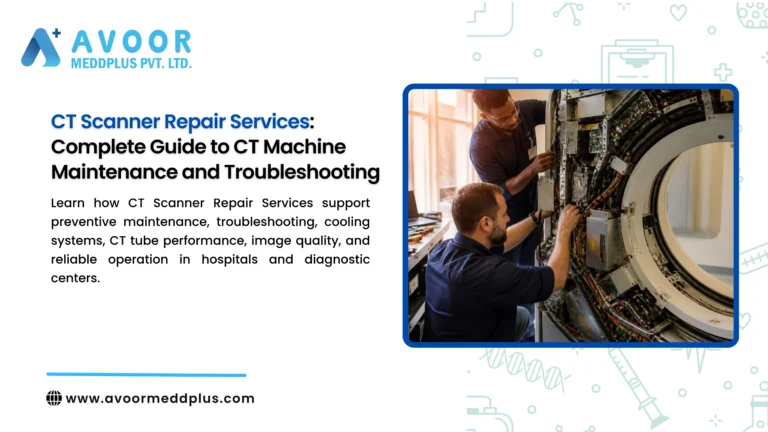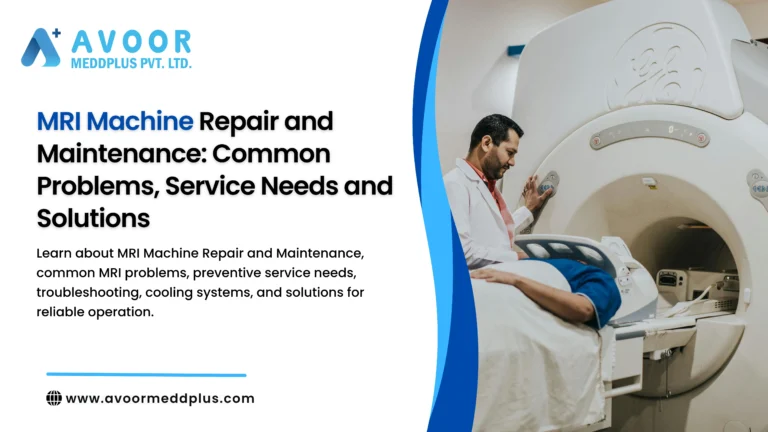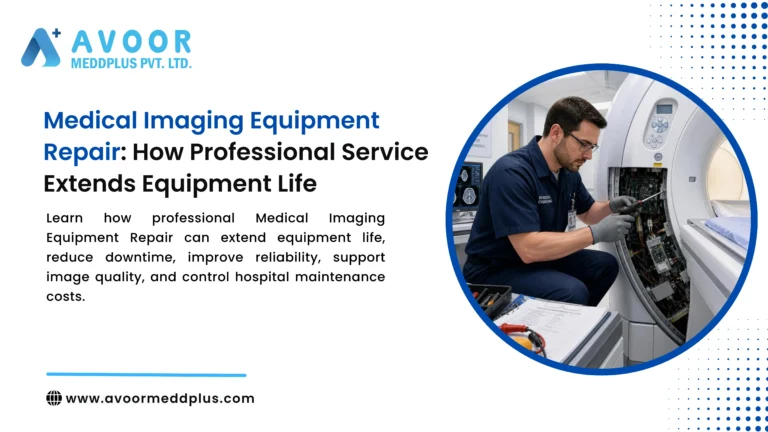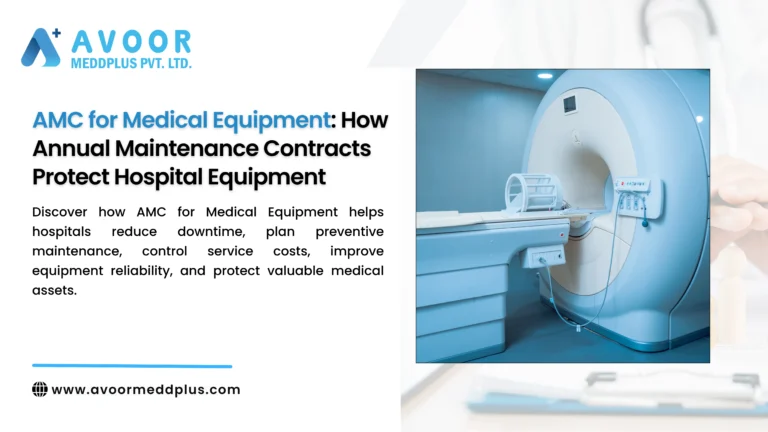

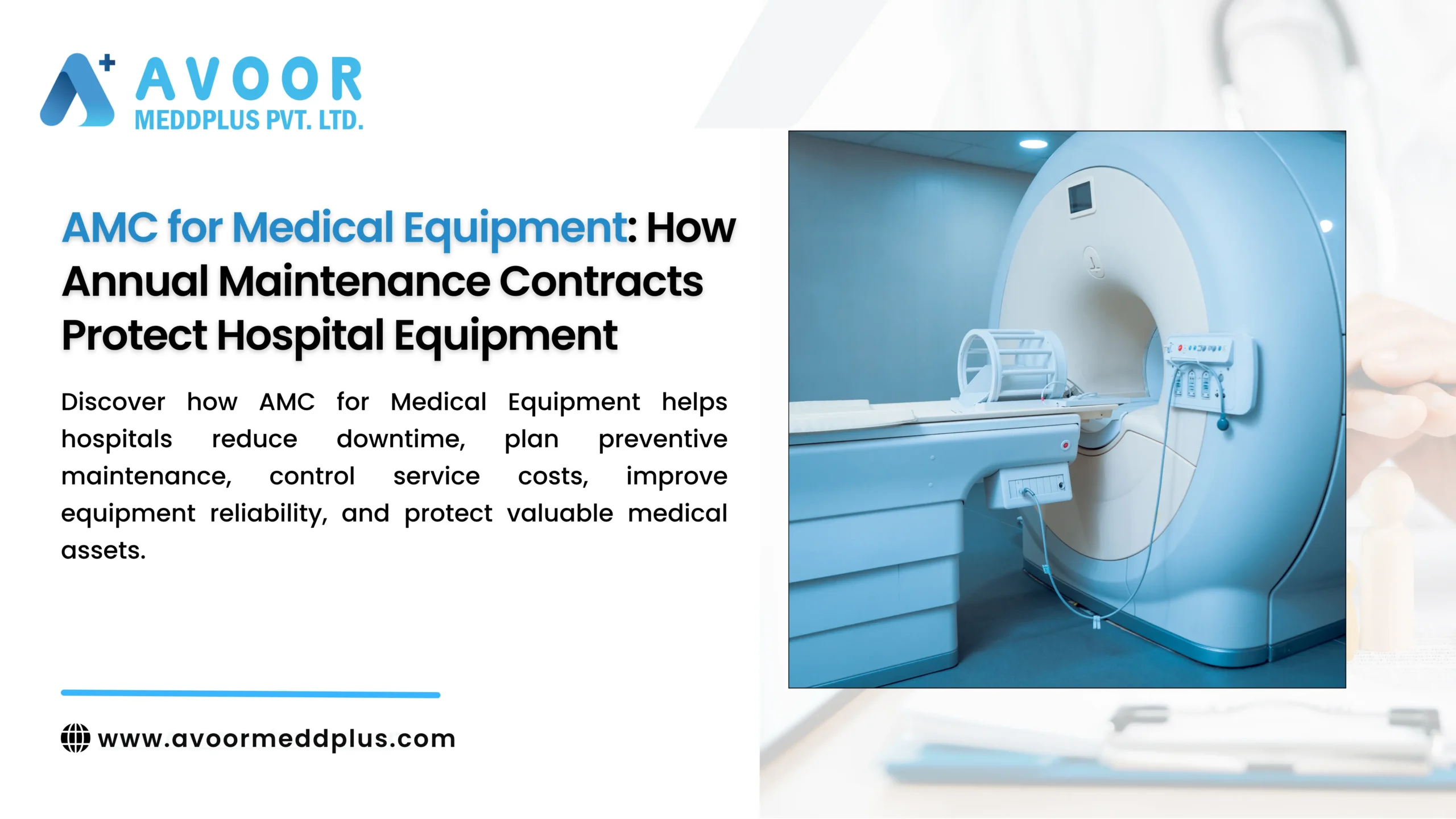
AMC for Medical Equipment can play an important role in helping hospitals and diagnostic centers maintain critical equipment and manage unexpected technical problems.
Healthcare facilities depend on medical equipment every day. CT scanners, MRI systems, PET/CT systems, X-ray machines, ultrasound systems, C-Arms, patient monitors, laboratory equipment, and other devices support diagnosis, treatment, and patient monitoring.
When critical equipment fails unexpectedly, the impact can extend beyond the repair itself.
A breakdown can lead to:
- Appointment delays
- Diagnostic interruptions
- Equipment downtime
- Emergency service requirements
- Higher repair costs
- Patient inconvenience
- Workflow disruption
An appropriately structured Annual Maintenance Contract (AMC) provides a planned framework for preventive maintenance and technical support.
However, not every AMC provides the same level of coverage. Hospitals should carefully evaluate the equipment, service requirements, response times, parts coverage, exclusions, and preventive-maintenance scope before entering into an agreement.
This guide explains what an AMC is, how it can protect hospital equipment, what should be included in a medical equipment maintenance contract, and how healthcare facilities can choose the right service arrangement.
Table of Contents
- What Is AMC for Medical Equipment?
- Why Hospitals Need Equipment Maintenance Contracts
- 10 Benefits of AMC for Medical Equipment
- What Does a Medical Equipment AMC Include?
- AMC vs CAMC for Medical Equipment
- Which Medical Equipment Can Be Covered?
- How to Choose the Right AMC Provider
- Medical Equipment AMC Checklist
- Common AMC Mistakes Hospitals Should Avoid
- When Is an AMC Worth Considering?
- Why Choose Avoor Meddplus Pvt Ltd?
- Frequently Asked Questions
- Conclusion
What Is AMC for Medical Equipment?
Understanding AMC for Medical Equipment
AMC for Medical Equipment stands for an Annual Maintenance Contract for Medical Equipment.
It is a service agreement between a healthcare facility and a technical service provider covering defined maintenance and support activities for a specified period, usually one year.
Depending on the contract, an AMC may include:
- Preventive maintenance
- Equipment inspection
- Functional testing
- Troubleshooting
- Corrective repair
- Technical support
- Emergency service
- Calibration support
- Service reports
- Scheduled maintenance visits
The exact scope varies significantly between service providers and equipment.
Therefore, hospitals should never assume that all parts, labor, repairs, or emergency visits are automatically included.
The contract should clearly state what is covered and what is excluded.
Why Hospitals Need Equipment Maintenance Contracts
Hospitals operate equipment in environments where availability is important.
A CT scanner that is unavailable for several days can affect scheduled examinations.
Similarly, a malfunctioning MRI system can disrupt an entire diagnostic workflow.
A maintenance contract provides a structured way to manage equipment servicing rather than arranging technical support only after a breakdown occurs.
Planned Maintenance vs Emergency Repair
Without an organized maintenance plan, equipment may be serviced primarily when something goes wrong.
An AMC can provide scheduled preventive maintenance that may help identify potential problems before they become major failures.
This does not guarantee zero downtime.
Instead, the objective is to create a more predictable maintenance process.
10 Benefits of AMC for Medical Equipment
1. Helps Reduce Unexpected Downtime
One of the major reasons hospitals consider AMC for Medical Equipment is equipment availability.
Scheduled maintenance can identify certain issues before they develop into major failures.
Preventive inspections may include:
- Mechanical checks
- Electrical checks
- Performance testing
- Error-log review
- Cooling-system checks
- Component inspection
The exact maintenance activities depend on the equipment.
2. Supports Preventive Maintenance
Preventive maintenance is central to an effective equipment-service strategy.
An AMC can establish defined maintenance intervals for equipment.
For example, maintenance schedules can be created for:
- CT scanners
- MRI systems
- X-ray equipment
- PET/CT
- SPECT/CT
- Ultrasound
- C-Arms
- Patient monitors
- Laboratory systems
Manufacturer recommendations should remain the primary technical reference for maintenance requirements.
3. Provides Faster Access to Technical Support
When a critical system fails, finding a qualified technician at short notice can be difficult.
An AMC can establish a predefined service relationship.
Depending on the contract, this may provide:
- Defined response time
- Technical support
- On-site service
- Remote troubleshooting
- Escalation procedures
Response times should always be clearly stated in the agreement.
4. Makes Maintenance Costs More Predictable
Unexpected repairs can create unplanned expenses.
An AMC provides a defined service cost for the covered scope.
This can make budgeting easier for biomedical engineering departments and hospital management.
However, hospitals should carefully review exclusions because expensive components may not always be covered.
5. Helps Extend Equipment Service Life
Regular maintenance can help identify wear, deterioration, and performance issues.
Maintaining equipment according to manufacturer requirements can support reliable operation throughout its serviceable life.
Maintenance cannot prevent every failure, and it does not guarantee that equipment will last longer than its expected service life.
However, proactive maintenance can help facilities manage equipment condition more effectively.
6. Improves Service Documentation
A professional AMC should generate service records.
These can include:
- Preventive maintenance reports
- Breakdown reports
- Parts replaced
- Error codes
- Equipment condition
- Technician observations
- Recommendations
- Next service date
These records can become valuable when planning future repairs, replacement, or capital expenditure.
7. Helps Identify Recurring Equipment Problems
A good maintenance history can reveal patterns.
For example:
If the same equipment develops similar faults repeatedly, management can investigate whether:
- A particular component is deteriorating
- Environmental conditions are contributing
- The equipment is approaching the end of its useful service life
- A larger technical issue exists
This allows maintenance decisions to be based on actual service history.
8. Supports Equipment Reliability
Reliability is particularly important for high-value imaging equipment.
A maintenance program can include appropriate inspections and performance checks for systems such as:
- MRI
- CT
- PET/CT
- SPECT/CT
- X-ray
- C-Arm
The specific maintenance requirements should be determined by equipment type and manufacturer.
9. Supports Better Biomedical Department Planning
Hospital biomedical engineering teams have to manage many different devices simultaneously.
An AMC can help organize:
- Service schedules
- Preventive maintenance
- Breakdown calls
- Vendor coordination
- Service documentation
- Equipment availability
This creates a more structured maintenance workflow.
10. Protects a Valuable Hospital Asset
Medical equipment can represent a major capital investment.
A maintenance contract provides a framework for keeping equipment serviced according to defined requirements.
For high-value systems, an AMC can therefore form part of the hospital’s broader asset-management strategy.
What Does a Medical Equipment AMC Include?
A properly written AMC should clearly define its scope.
Preventive Maintenance
The contract may specify:
- Number of preventive-maintenance visits
- Maintenance frequency
- Inspection procedures
- Performance checks
- Calibration support
- Service reporting
Corrective Maintenance
The agreement may define support for:
- Equipment breakdowns
- Fault diagnosis
- Component replacement
- Troubleshooting
- System restoration
Emergency Support
Some agreements provide emergency service outside scheduled maintenance visits.
The contract should define:
- Response time
- Service hours
- Escalation procedure
- Emergency-call process
Spare Parts
This is one of the most important areas to clarify.
An AMC may be:
- Labor-only
- Labor + selected parts
- Comprehensive
- Limited to specific components
Hospitals should request a written list of included and excluded parts.
AMC vs CAMC for Medical Equipment
What Is AMC?
An Annual Maintenance Contract (AMC) generally covers defined maintenance and technical service activities.
Parts may or may not be included.
What Is CAMC?
A Comprehensive Annual Maintenance Contract (CAMC) generally provides broader coverage, potentially including specified spare parts and labor.
However, “comprehensive” does not necessarily mean every component is covered.
Exclusions can include items such as:
- Consumables
- Accessories
- External damage
- Certain high-value components
- Batteries
- Third-party modifications
- Misuse-related damage
The exact contract must be reviewed before signing.
AMC vs CAMC Comparison
| Feature | AMC | CAMC |
|---|---|---|
| Preventive Maintenance | Usually included | Usually included |
| Technical Support | As defined in contract | As defined in contract |
| Corrective Repair | Contract dependent | Usually broader |
| Spare Parts | May be excluded | May be included |
| Labor | Usually defined | Usually defined |
| Emergency Support | Contract dependent | Contract dependent |
| Cost Predictability | Moderate to high | Generally higher |
| Coverage | Limited/defined | Broader/defined |
Which Medical Equipment Can Be Covered?
An AMC can potentially be used for many types of hospital and diagnostic equipment.
Medical Imaging Equipment
- MRI
- CT
- PET/CT
- SPECT/CT
- X-ray
- C-Arm
- Mammography
- Ultrasound
- Fluoroscopy
Patient-Care Equipment
- Patient monitors
- ECG systems
- Infusion pumps
- Defibrillators
- Ventilators
- Anesthesia machines
Laboratory Equipment
Depending on service capability:
- Laboratory analyzers
- Centrifuges
- Microscopes
- Refrigeration equipment
- Other laboratory systems
The service scope should always be matched to the specific equipment model.
AMC for Medical Imaging Equipment
High-value imaging equipment can benefit from carefully structured maintenance programs.
CT Scanner AMC
An appropriate service agreement may cover:
- Preventive inspection
- Error-log review
- Cooling checks
- Mechanical inspection
- Performance testing
- Corrective troubleshooting
CT tube and other high-value components should be specifically addressed in the contract.
Read our related article: [CT Scanner Repair and Maintenance].
MRI AMC
MRI maintenance requires specialized expertise.
Depending on the agreement, support may cover:
- Preventive maintenance
- System diagnostics
- Cooling systems
- RF components
- Gradient systems
- Coils
- Error analysis
Read our related article: [MRI Machine Repair and Maintenance].
PET/CT AMC
PET/CT combines PET and CT technology.
A maintenance contract may cover:
- PET system checks
- CT subsystem support
- Calibration support
- Cooling systems
- Error diagnosis
- Preventive maintenance
Read our related article: [PET/CT Repair and Maintenance].
How to Choose the Right AMC Provider
Selecting the right service provider is as important as selecting the contract itself.
1. Check Technical Expertise
Ask whether the provider has experience with your specific:
- Equipment manufacturer
- Model
- System generation
- Technology
Experience with similar equipment can make troubleshooting more efficient.
2. Review Response Time
Do not accept vague statements such as “quick response.”
Ask for a defined service-level commitment.
For example:
- Remote response
- Engineer dispatch
- On-site response
- Escalation
These should be documented in the agreement.
3. Check Parts Availability
For older equipment, parts availability can become a major issue.
Ask:
- Are spare parts available?
- Are refurbished parts permitted?
- Are third-party parts used?
- What happens if a manufacturer no longer supports the equipment?
4. Review Exclusions Carefully
Before signing, identify exactly what is excluded.
A low-cost AMC with extensive exclusions may provide less practical protection than a slightly more expensive agreement with better coverage.
5. Check Service Documentation
A professional provider should provide service reports after maintenance visits.
6. Ask About Emergency Support
Find out whether emergency service is available:
- During business hours
- After hours
- On weekends
- During holidays
Medical Equipment AMC Checklist
Before signing an AMC, hospitals should review the following:
Equipment Details
- Manufacturer
- Model
- Serial number
- Installation location
- Equipment age
- Current condition
Maintenance Scope
- Preventive maintenance frequency
- Inspection scope
- Calibration
- Performance testing
- Cleaning requirements
- Service reports
Breakdown Support
- Response time
- On-site support
- Emergency service
- Remote support
- Escalation process
Spare Parts
- Included parts
- Excluded parts
- High-value component coverage
- Consumables
- Accessories
Contract Management
- Contract duration
- Service schedule
- Pricing
- Renewal terms
- Termination conditions
- Service-level commitments
Common AMC Mistakes Hospitals Should Avoid
Choosing Only on Price
The cheapest AMC is not necessarily the best.
Consider:
- Coverage
- Response time
- Technical expertise
- Parts availability
- Service documentation
- Equipment criticality
Not Reading Exclusions
Always read the exclusion section carefully.
No Defined Response Time
A maintenance contract without a clear service-response commitment may not provide sufficient protection during equipment downtime.
Ignoring Equipment Age
Older equipment may require more frequent repairs and have limited parts availability.
Not Reviewing Service History
Before renewing an AMC, review the previous year’s:
- Breakdown frequency
- Downtime
- Repair costs
- Parts replaced
- Recurring failures
This can help determine whether the current contract remains appropriate.
When Is an AMC Worth Considering?
An AMC can be particularly useful for:
- High-value imaging equipment
- Mission-critical clinical equipment
- Frequently used equipment
- Equipment with limited in-house technical support
- Older equipment requiring regular service
- Systems where downtime significantly affects operations
However, the decision should be based on the equipment’s risk, value, age, service history, availability of technical expertise, and total cost of ownership.
Why Choose Avoor Meddplus Pvt Ltd?
Avoor Meddplus Pvt Ltd provides professional AMC for Medical Equipment for hospitals, diagnostic centers, and healthcare organizations.
Our maintenance and technical support capabilities include:
- Medical Equipment AMC
- Preventive Maintenance
- Corrective Maintenance
- CT Scanner Service
- MRI Service
- PET/CT Service
- SPECT/CT Service
- X-Ray Equipment Service
- C-Arm Service
- Medical Equipment PCB Repair
- Electronic Fault Diagnosis
- Calibration Support
- Spare Parts Support
- Installation and Commissioning
- Technical Troubleshooting
Our service approach focuses on preventive maintenance, systematic troubleshooting, accurate documentation, and practical technical support.
For hospitals managing critical medical equipment, a structured AMC can help create a more predictable maintenance process and improve equipment-service planning.
Conclusion
AMC for Medical Equipment can provide hospitals and diagnostic centers with a structured approach to maintaining valuable medical equipment.
A well-designed annual maintenance contract can support:
- Preventive maintenance
- Equipment reliability
- Technical support
- Service planning
- Documentation
- Cost predictability
- Faster response to equipment problems
However, the value of an AMC depends heavily on the contract’s actual scope.
Hospitals should carefully review preventive-maintenance requirements, response times, emergency support, parts coverage, exclusions, service documentation, and technical expertise before signing an agreement.
For high-value equipment such as MRI, CT, PET/CT, SPECT/CT, X-ray, and C-Arm systems, selecting an experienced service provider can be particularly important.
The objective should not simply be to purchase a maintenance contract. It should be to establish a reliable equipment-support strategy that matches the clinical importance, technical complexity, and service requirements of each device.
Need AMC for Medical Equipment?
Avoor Meddplus Pvt Ltd provides professional AMC, preventive maintenance, corrective repair, troubleshooting, calibration support, spare-parts assistance, and technical services for medical equipment.