
Introduction
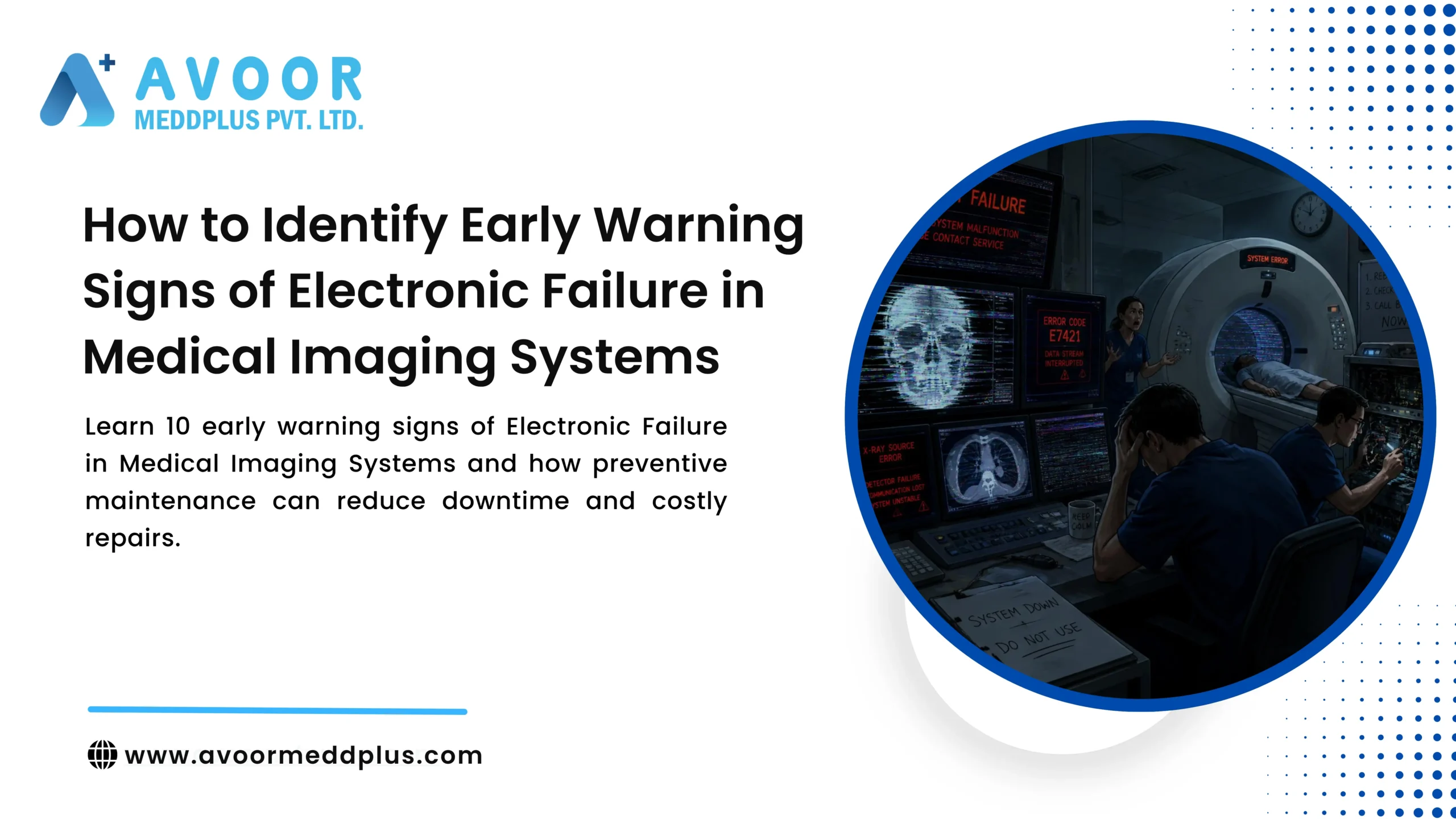
Electronic Failure in Medical Imaging Systems can develop gradually before becoming a major equipment breakdown. Modern CT scanners, MRI systems, PET/CT systems, SPECT/CT equipment, digital X-ray systems, Cath Labs, C-Arms, mammography systems, and imaging workstations depend on sophisticated electronic components to acquire, process, transmit, and display diagnostic information.
Circuit boards, power supplies, detectors, control modules, sensors, communication interfaces, computers, and other electronic assemblies must work together continuously. A developing electronic problem may initially appear as an intermittent error, unexpected restart, communication issue, image-quality change, or unusual system behavior.Electronic Failure in Medical Imaging Systems.
Recognizing these early warning signs can help hospitals and diagnostic centers arrange professional inspection before a minor electronic issue develops into an extended equipment failure, Electronic Failure in Medical Imaging Systems.
Early diagnosis is particularly important for high-value imaging systems because unexpected downtime can affect patient appointments, diagnostic workflows, equipment utilization, and maintenance budgets.
What Causes Electronic Failure in Medical Imaging Systems?
Understanding Electronic Failure in Medical Imaging Systems
Electronic failures can have many causes. A single symptom does not necessarily identify the failed component.
Common contributing factors may include: Electronic Failure in Medical Imaging Systems>
- Component aging
- Electrical power fluctuations
- Excessive heat
- Cooling-system problems
- Dust accumulation
- Moisture or humidity
- Failed capacitors
- Power supply problems
- Connector deterioration
- PCB faults
- Sensor failure
- Communication problems
- Software and hardware interaction
- Repeated thermal stress
Environmental conditions can also influence electronic reliability. Poor cooling, excessive temperature, dust, and unstable electrical conditions may place additional stress on sensitive components.
For this reason, troubleshooting should focus on identifying the root cause rather than simply replacing the component associated with the first visible error.Electronic Failure in Medical Imaging Systems.
Why Early Detection Matters
Preventing Electronic Failure in Medical Imaging Systems
Early detection can provide several important benefits for healthcare facilities.
Reduced Downtime
Identifying a developing problem allows service teams to schedule corrective work before an unexpected breakdown occurs.
Lower Repair Costs
A smaller electronic issue may be easier to address before it affects additional components.
Better Equipment Availability
Reliable equipment helps imaging departments maintain patient schedules and clinical workflows.
Improved Maintenance Planning
Service teams can use error histories, equipment behavior, and maintenance records to identify recurring patterns.
Protection of Critical Components
Early intervention can help prevent secondary damage caused by electrical, thermal, or communication problems.
10 Early Warning Signs of Electronic Failure
1. Repeated Error Messages
One of the most common early warning signs is the repeated appearance of the same or related error messages.
A single temporary error may not necessarily indicate an electronic failure.
However, recurring errors can indicate a developing problem involving:
- Control boards
- Sensors
- Communication modules
- Power supplies
- Software
- Data acquisition systems
Operators should record the exact error message and frequency instead of repeatedly clearing the warning without investigating the cause.
2. Unexpected System Restarts
If an imaging system unexpectedly restarts during operation, the event should be documented and investigated.
Possible contributing factors may include:
- Power instability
- Power supply faults
- Overheating
- Computer hardware problems
- Software failures
- Electronic board problems
Repeated restarts are not normal operating behavior and should not be ignored.
3. Intermittent Equipment Failures
Intermittent problems can be particularly difficult to diagnose.
For example, a system may:
- Work normally in the morning
- Display an error later
- Recover after restarting
- Operate normally again
- Repeat the problem days later
This type of behavior can indicate an unstable electronic, thermal, power, or communication condition.
Maintaining a record of when the problem occurs can help engineers identify patterns.
4. Image Quality Changes
A sudden or unexplained change in image quality can sometimes be associated with electronic or detector-related problems.
Possible symptoms include:
- Increased image noise
- Unexpected artifacts
- Lines or bands
- Inconsistent image appearance
- Missing data
- Calibration problems
However, image artifacts can have many causes. They should not automatically be attributed to electronic failure.
If image-quality changes occur together with equipment errors or unusual system behavior, professional technical evaluation is recommended.
5. Equipment Takes Longer to Start
A noticeable increase in startup time can be an early indication of a problem involving:
- System computers
- Storage devices
- Power supplies
- Communication modules
- Software services
- Internal hardware
A gradual change in startup performance is worth documenting, especially if other symptoms appear at the same time.
6. Communication Errors Between Modules
Modern imaging systems contain multiple interconnected electronic modules.
Communication errors may occur between:
- Detectors
- Gantry electronics
- Control computers
- Acquisition systems
- Reconstruction systems
- Workstations
- PACS interfaces
A recurring communication error may originate from a cable, connector, network, interface board, software process, or electronic module.
Professional diagnostics are required to identify the actual source.
7. Unusual Heat or Overheating Warnings
Electronic components are sensitive to excessive heat.
A rise in operating temperature may be caused by:
- Cooling fan failure
- Restricted airflow
- Dust accumulation
- HVAC problems
- Power component degradation
- Internal electronic faults
Repeated temperature warnings should be investigated promptly.
This is particularly important for CT systems, where high-power components and electronic assemblies generate substantial heat.
8. Unusual Sounds from Electronic or Cooling Components
Unusual sounds can provide useful clues about developing equipment problems.
Examples include:
- Fan noise
- Clicking
- Repeated relay sounds
- Grinding from cooling components
- Unusual vibration
Not every unusual sound indicates an electronic failure. However, a new sound combined with equipment warnings or performance changes should be investigated.
Operators should not open equipment cabinets to investigate internal sounds unless they are specifically qualified and authorized to do so.
9. Calibration or Self-Test Failures
Medical imaging systems perform various startup checks, calibrations, and self-tests.
Repeated failure may indicate a problem involving:
- Detectors
- Sensors
- Electronic boards
- Power supplies
- Communication systems
- Software configuration
Calibration failures can affect equipment availability and potentially image performance, so recurring failures should receive professional attention.
10. Increasing Frequency of Minor Faults
Sometimes the most important warning sign is not one major error but a pattern of smaller problems.
For example:
- More frequent warnings
- Repeated restarts
- Increasing calibration failures
- More communication errors
- Longer startup times
- Occasional system freezes
Individually, these events may appear minor.
Together, however, they can indicate that equipment condition is changing.
A service engineer can review the complete fault history to determine whether the problems are connected.
Electronic Failure in CT, MRI, PET/CT and SPECT/CT
CT Scanner Electronic Failure
CT scanners depend on numerous electronic subsystems, including:
- Data acquisition electronics
- Detector interfaces
- Gantry control systems
- Power electronics
- Computer systems
- Communication boards
- Control circuits
Electronic problems may appear as communication errors, calibration failures, unexpected shutdowns, image artifacts, or system initialization problems.
Repeated faults should be evaluated using equipment-specific service information.
MRI Electronic Failure
MRI systems contain complex electronic and computing systems associated with:
- RF systems
- Gradient systems
- Signal processing
- Control computers
- Patient monitoring
- Communication interfaces
MRI systems have specialized safety requirements. Technical troubleshooting should therefore be performed by appropriately trained and authorized professionals.
PET/CT Electronic Failure
PET/CT systems combine PET detector technology with CT imaging and advanced computing.
Potential electronic warning signs include:
- Detector communication errors
- Acquisition problems
- Calibration failures
- Workstation issues
- CT subsystem errors
- Data-transfer problems
Because multiple systems are integrated, a detailed diagnostic process is often necessary.
SPECT/CT Electronic Failure
SPECT/CT systems combine gamma-camera technology with CT components.
Potential warning signs may involve:
- Detector communication
- Acquisition electronics
- Calibration
- Gantry controls
- Image-processing systems
- Workstation communication
Recurring faults should be documented and evaluated by qualified service personnel.
How Preventive Maintenance Helps
Preventing Electronic Failure in Medical Imaging Systems
Preventive maintenance is one of the most effective ways to identify developing electronic problems.
Depending on the equipment, professional maintenance may include:
- Visual inspection
- Electrical safety checks
- Cooling-system inspection
- Power-supply evaluation
- Error-log review
- Connector inspection
- Performance testing
- Calibration verification
- System diagnostics
- PCB inspection
- Software and configuration checks
Maintenance should follow the manufacturer’s service requirements and applicable facility procedures.
The Importance of Medical Equipment PCB Repair
Printed circuit boards are essential components in modern medical imaging systems.
A PCB may control or support:
- Power distribution
- Communication
- Signal processing
- Detector interfaces
- Motor control
- System monitoring
- Data acquisition
When a board develops a fault, replacing the entire assembly may not always be the only possible service approach.
Depending on the equipment, component availability, manufacturer requirements, and technical feasibility, specialized PCB diagnostics and repair may provide an alternative.
Any PCB repair should be performed by appropriately qualified technical personnel using suitable diagnostic equipment and procedures.
What to Do When Electronic Problems Appear
When an imaging system begins showing unusual electronic behavior, healthcare facilities should follow a structured response.
Step 1: Record the Symptoms
Document:
- Error code
- Warning message
- Date and time
- Equipment model
- Operating conditions
- Frequency of the problem
Step 2: Check Approved Operator Procedures
Follow the manufacturer’s operator instructions and facility procedures.
Only perform troubleshooting actions authorized for operators.
Step 3: Avoid Repeated Resets
If the same fault keeps returning, repeatedly restarting the system may only temporarily clear the symptom.
The underlying cause should be investigated.
Step 4: Preserve Relevant Information
Error logs, screenshots, service records, and fault histories can help technical engineers diagnose intermittent problems.
Ensure that screenshots or records do not contain patient-identifying information.
Step 5: Contact Qualified Technical Support
If the problem affects equipment safety, image quality, system availability, or normal operation, arrange professional service.
When to Call a Medical Imaging Equipment Expert
Contact a qualified service engineer when:
- The same error repeatedly occurs
- The system unexpectedly shuts down
- Image quality changes unexpectedly
- Calibration repeatedly fails
- Communication errors increase
- Equipment overheating warnings appear
- Startup becomes unusually slow
- System freezes or restarts
- Multiple minor faults begin occurring
- Equipment becomes unavailable for clinical use
Early professional diagnosis can help determine whether the problem involves electronics, software, cooling, power, networking, or another subsystem.
Why Choose Avoor Meddplus Pvt Ltd?
Avoor Meddplus Pvt Ltd provides professional repair, preventive maintenance, installation, technical diagnostics, and spare parts support for medical imaging equipment.
Our service capabilities include:
- CT Scanner Repair
- MRI Repair and Maintenance
- PET/CT Service Support
- SPECT/CT Service
- Medical Equipment PCB Repair
- Electronic Fault Diagnosis
- Preventive Maintenance
- Equipment Calibration Support
- AMC Services
- CAMC Services
- Per-Call Technical Support
- Medical Imaging Spare Parts
Our technical approach focuses on identifying the underlying cause of equipment faults rather than simply clearing error messages or replacing components without diagnosis.
For hospitals and diagnostic centers experiencing recurring electronic faults, early technical intervention can help reduce unexpected downtime and protect valuable imaging equipment.
Frequently Asked Questions
What are the early signs of Electronic Failure in Medical Imaging Systems?
Common warning signs include repeated error messages, unexpected restarts, communication failures, calibration problems, image-quality changes, overheating warnings, slow startup, and increasing frequency of minor faults.
Can electronic failure affect CT image quality?
Yes, electronic problems involving detectors, data acquisition, signal processing, or related components can potentially affect image acquisition or quality. However, image artifacts can have many causes and require proper diagnosis.
Can overheating cause electronic component failure?
Excessive heat can place additional stress on electronic components. Cooling-system problems should therefore be investigated when repeated temperature warnings occur.
Why does my medical imaging equipment keep restarting?
Repeated restarts may be associated with power instability, overheating, software problems, computer hardware, power supplies, or electronic faults. A qualified engineer should identify the actual cause.
Can PCB repair solve medical imaging equipment problems?
In some cases, specialized PCB diagnosis and repair may be technically feasible. The decision depends on the board, fault, equipment model, component availability, and applicable service requirements.
Should operators reset equipment after an error?
Operators should follow manufacturer-approved procedures and facility protocols. Repeated errors should not simply be cleared without determining why they are occurring.
How can preventive maintenance identify electronic problems?
Preventive maintenance can include inspection, error-log analysis, electrical testing, cooling checks, performance verification, calibration, and other equipment-specific diagnostics.
When should a hospital call a medical equipment service provider?
Professional support should be requested when faults repeatedly occur, affect image quality, cause unexpected shutdowns, compromise normal operation, or create safety concerns.
Conclusion
Electronic Failure in Medical Imaging Systems does not always begin with a complete equipment breakdown.
In many cases, the first signs can be subtle: a recurring error message, an unexpected restart, a calibration failure, a communication problem, unusual heat, slower startup, or an increasing number of minor faults.
Recognizing these warning signs early gives hospitals and diagnostic centers an opportunity to investigate the underlying problem before it results in extended downtime.
A structured preventive maintenance program, appropriate environmental control, equipment monitoring, error-log review, and professional technical diagnosis can help improve the reliability of CT, MRI, PET/CT, SPECT/CT, digital X-ray, and other imaging systems.
The key is to treat recurring changes in equipment behavior as useful diagnostic information rather than simply resetting the system and continuing operation.
Need Medical Imaging Equipment Repair Support?
Avoor Meddplus Pvt Ltd provides professional support for:
- Medical Imaging Equipment Repair
- CT Scanner Repair
- MRI Maintenance
- PET/CT Service
- SPECT/CT Support
- Medical Equipment PCB Repair
- Electronic Fault Diagnosis
- Preventive Maintenance
- AMC & CAMC Services
- Medical Imaging Spare Parts
Contact Avoor Meddplus Pvt Ltd for professional medical imaging equipment repair, maintenance, and technical support.