
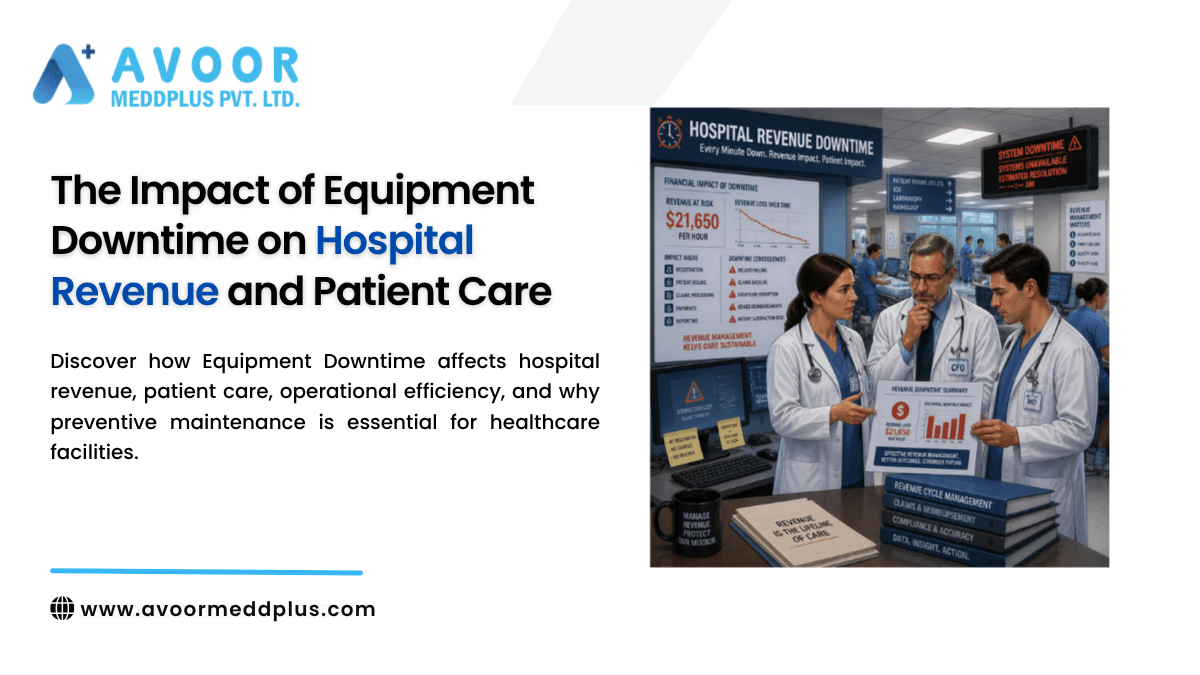
The Impact of Equipment Downtime on Hospital Revenue and Patient Care
Table of Contents
- Introduction
- What Is Equipment Downtime?
- Common Causes of Equipment Downtime
- How Equipment Downtime Affects Hospitals
- 10 Major Impacts of Equipment Downtime
- How Preventive Maintenance Reduces Downtime
- Why Choose Avoor Meddplus Pvt Ltd?
- Frequently Asked Questions
- Conclusion
Introduction
Equipment Downtime is one of the most significant operational challenges faced by hospitals, diagnostic centers, and healthcare institutions. Modern healthcare depends heavily on advanced medical imaging systems such as CT scanners, MRI systems, PET/CT scanners, digital X-ray machines, ultrasound systems, and Cath Lab equipment. When these critical systems become unavailable, the consequences extend far beyond repair costs.
Every hour of Equipment Downtime can lead to delayed diagnoses, cancelled appointments, reduced patient satisfaction, financial losses, and increased pressure on healthcare professionals. Hospitals that rely on uninterrupted imaging services understand that maintaining equipment reliability is essential for delivering quality patient care while protecting revenue.
A proactive maintenance strategy helps healthcare facilities minimize downtime, improve equipment performance, and ensure continuous clinical operations.
What Is Equipment Downtime?
Understanding Equipment Downtime
Equipment Downtime refers to the period during which medical equipment is unavailable for clinical use due to malfunction, preventive maintenance, software issues, component failure, or unexpected technical problems.
Downtime can be:
Planned Downtime
This includes scheduled activities such as:
- Preventive maintenance
- Calibration
- Software upgrades
- Equipment inspections
- Safety testing
Planned downtime is controlled and usually has minimal impact on hospital operations.
Unplanned Downtime
Unplanned downtime occurs unexpectedly because of:
- Hardware failures
- Electrical faults
- Cooling system problems
- Software crashes
- Detector failures
- Power supply issues
- Mechanical breakdowns
Unplanned downtime is far more costly because it disrupts patient services and clinical workflows.
Common Causes of Equipment Downtime
Several factors contribute to Equipment Downtime in healthcare facilities.
Aging Equipment
Older medical imaging systems naturally experience increased wear and component degradation, making them more prone to unexpected failures.
Lack of Preventive Maintenance
Skipping routine inspections often allows minor issues to develop into major equipment failures.
Software Problems
Outdated firmware, corrupted operating systems, and configuration errors can interrupt equipment functionality.
Electrical Issues
Voltage fluctuations, unstable power supplies, damaged cables, and grounding problems frequently affect imaging equipment performance.
Environmental Factors
Dust accumulation, excessive heat, humidity, and inadequate cooling can shorten the lifespan of sensitive electronic components.
Improper Equipment Usage
Incorrect operating procedures and inadequate user training can increase equipment wear and contribute to premature failures.
Why Equipment Downtime Is a Major Concern
Healthcare facilities depend on continuous equipment availability to provide timely diagnoses and treatments.
Unexpected downtime can affect:
- Patient scheduling
- Clinical workflows
- Emergency care
- Physician productivity
- Hospital reputation
- Financial performance
Hospitals with reliable equipment experience higher operational efficiency and better patient outcomes.
10 Major Impacts of Equipment Downtime
1. Revenue Loss from Cancelled Appointments
Every cancelled CT scan, MRI examination, PET/CT procedure, or digital X-ray represents lost revenue. High-value imaging systems generate significant daily income, making downtime extremely expensive.
Hospitals may lose thousands of dollars in revenue for every day an imaging system remains out of service.
2. Delayed Patient Diagnosis
When imaging equipment becomes unavailable, patients often experience delayed diagnoses and postponed treatment plans.
Early diagnosis is essential for many medical conditions, making equipment availability critical to patient outcomes.
3. Increased Patient Waiting Times
Downtime causes appointment backlogs, longer waiting lists, and scheduling challenges.
Patients may need to:
- Wait several additional days
- Travel to another healthcare facility
- Reschedule diagnostic procedures
This negatively affects the patient experience.
4. Reduced Clinical Productivity
Radiologists, technicians, and physicians depend on imaging systems throughout the day.
When equipment fails:
- Staff productivity declines
- Clinical workflows slow
- Resources remain underutilized
- Operational efficiency decreases
5. Higher Emergency Repair Costs
Unexpected failures usually require urgent technical support.
Emergency repairs often involve:
- Premium service charges
- Expedited spare parts
- Extended engineering hours
- Higher transportation costs
Preventive maintenance is typically much less expensive than emergency repairs.
How Preventive Maintenance Reduces Equipment Downtime
Hospitals can significantly reduce Equipment Downtime by implementing structured preventive maintenance programs.
Routine maintenance includes:
- Equipment inspections
- Electrical safety testing
- Calibration verification
- Cooling system cleaning
- Performance testing
- Software updates
- Mechanical inspections
- Replacement of worn components
A proactive maintenance strategy identifies potential failures before they interrupt clinical operations.
Equipment Most Vulnerable to Downtime
Healthcare facilities should closely monitor:
- CT Scanners
- MRI Systems
- PET/CT Systems
- SPECT Systems
- Digital X-ray Machines
- Mammography Systems
- Ultrasound Equipment
- Cath Lab Systems
- C-Arm Machines
- PACS Servers
- Diagnostic Workstations
These high-value systems require routine servicing to maintain peak performance and reliability.