Introduction
Medical equipment is the backbone of modern healthcare. From imaging systems like CT, PET/CT, DR, and C-ARM to critical biomedical devices used in daily patient care, hospitals rely on these systems to function accurately and safely. However, one of the most common and dangerous practices in healthcare operations is postponing maintenance until a failure occurs.
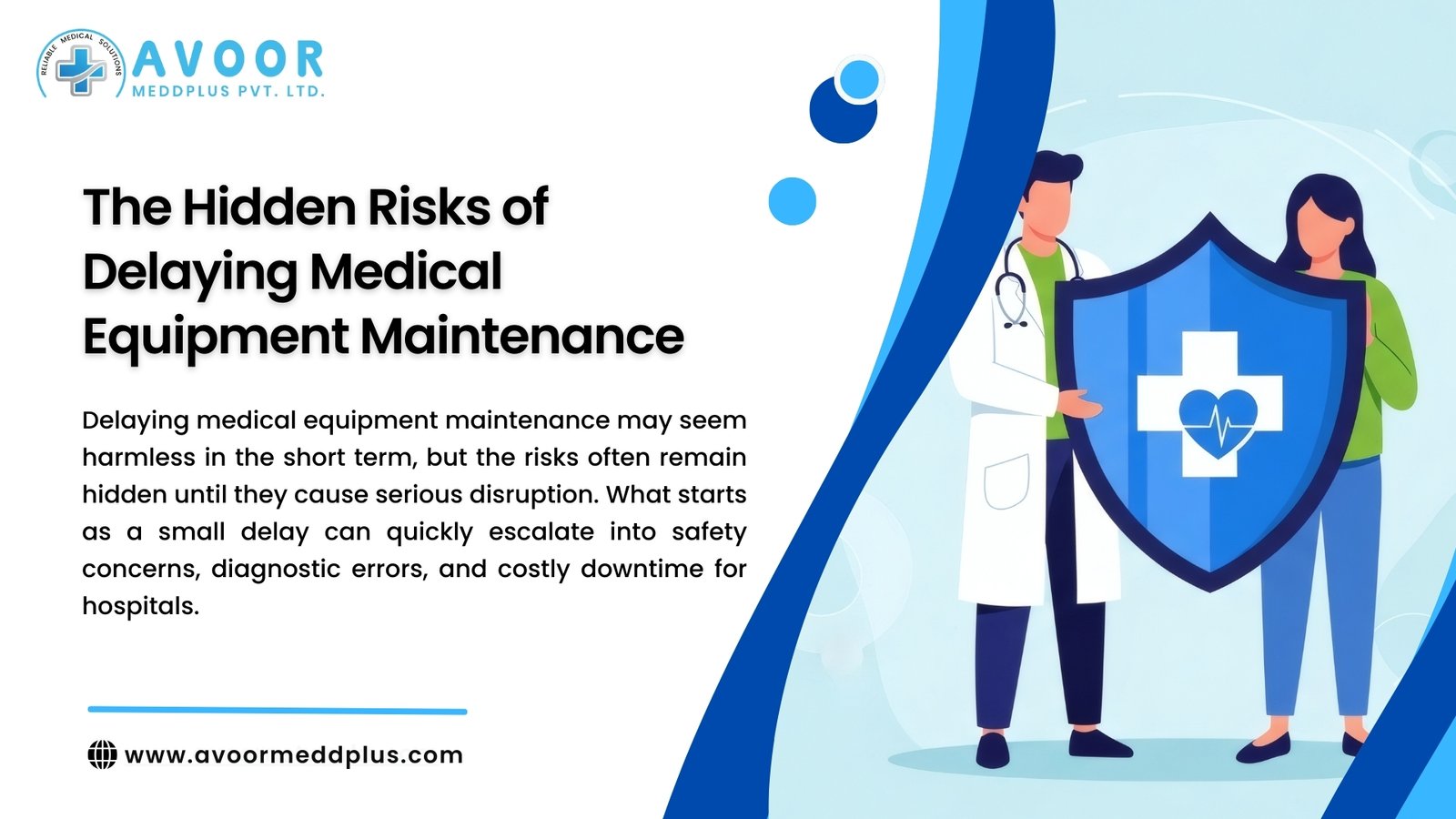
The hidden risks of delaying medical equipment maintenance often remain unnoticed until they cause serious clinical, financial, or compliance-related consequences. What appears to be a short-term cost-saving decision can quickly escalate into long-term operational risk. At Avoor Meddplus, delayed maintenance is one of the leading root causes observed behind avoidable breakdowns, downtime, and safety issues in hospitals.
1. Delayed Maintenance Leads to Sudden and Costly Equipment Failure
Medical equipment rarely fails without warning. Most breakdowns are the result of small issues that were left unattended overheating components, calibration drift, power instability, or worn mechanical parts.
When maintenance is delayed:
- Minor faults escalate into major failures
- Emergency repairs become unavoidable
- Equipment may remain down for extended periods
Unplanned breakdowns are far more expensive than scheduled preventive maintenance and often disrupt critical hospital workflows.
2. Increased Risk to Patient Safety
One of the most serious hidden risks of delaying medical equipment maintenance is compromised patient safety. Equipment that is not properly maintained may still operate but deliver inaccurate or unsafe performance.
Potential safety risks include:
- Incorrect diagnostic images
- Inaccurate radiation dose delivery
- Electrical safety hazards
- Unstable system behavior during procedures
In imaging and interventional environments, even small deviations can directly impact diagnosis and treatment outcomes.
3. Degradation of Diagnostic Accuracy
Delayed maintenance often causes gradual performance drift rather than immediate failure. Calibration errors, detector instability, or software misalignment may go unnoticed while image quality slowly deteriorates.
This can result in:
- Poor image clarity
- Increased noise or artifacts
- Misinterpretation by clinicians
- Repeat scans and higher radiation exposure
Preventive maintenance is essential to preserve diagnostic accuracy and clinical confidence.
4. 6 Hidden Risks of Delaying Medical Equipment Maintenance
1️⃣ Escalating Repair Costs
What starts as a minor adjustment can become a major repair when ignored. Delayed maintenance often leads to:
- Replacement of expensive assemblies
- Higher spare part consumption
- Increased labor and downtime costs
Preventive maintenance controls costs by addressing issues early.
2️⃣ Increased Equipment Downtime
Hospitals that delay maintenance experience more frequent and longer downtime. Emergency breakdowns are unpredictable and often occur during peak operating hours, disrupting patient schedules and staff availability.
3️⃣ Regulatory and Compliance Exposure
Healthcare equipment must meet strict safety and performance standards. Delaying maintenance increases the risk of non-compliance during audits.
Key compliance risks include:
- Missing preventive maintenance records
- Outdated calibration certificates
- Incomplete safety test documentation
Audit failures can result in penalties, warnings, or operational restrictions.
4️⃣ Reduced Equipment Lifespan
Equipment that is not maintained regularly experiences accelerated wear. Heat buildup, electrical stress, and mechanical imbalance shorten the usable life of critical components such as tubes, detectors, and power boards.
Delayed maintenance directly reduces return on investment for high-value medical equipment.
5️⃣ Increased Burden on Clinical Staff
Frequent equipment issues force clinicians and technicians to adapt constantly. Rescheduling patients, repeating scans, and troubleshooting during procedures increases stress and reduces efficiency.
Reliable equipment performance is essential for smooth clinical operations.
6️⃣ Loss of Trust and Reputation
Repeated equipment failures can erode trust among clinicians and patients. In diagnostic centers, downtime may also impact referrals and institutional reputation.
Maintenance reliability plays a quiet but powerful role in maintaining hospital credibility.
5. Preventive Maintenance vs Delayed Maintenance
| Aspect | Preventive Maintenance | Delayed Maintenance |
|---|---|---|
| Failure Risk | Low | High |
| Downtime | Planned | Sudden |
| Repair Cost | Controlled | Escalated |
| Safety | Proactively managed | Compromised |
| Compliance | Audit-ready | High-risk |
| Equipment Life | Extended | Reduced |
This comparison highlights why delaying maintenance creates more risk than savings.
6. Impact Across Medical Imaging Modalities
Delayed maintenance affects all imaging systems:
CT & PET/CT
- Gantry misalignment
- Detector calibration drift
- Cooling and tube stress
DR & CR
- Flat-panel detector degradation
- Exposure inconsistency
- Image quality variation
C-ARM
- Fluoroscopy output instability
- Radiation safety risk
- Mechanical wear
SPECT/CT & Nuclear Medicine
- Energy peaking errors
- Fusion misalignment
- Reduced quantitative accuracy
Each modality requires timely maintenance to prevent hidden failures.
7. Role of Biomedical Engineers in Preventing These Risks
Certified biomedical engineers play a critical role in identifying early warning signs that non-technical teams may overlook. Their expertise allows them to:
- Detect subtle performance drift
- Perform timely calibration
- Ensure electrical and radiation safety
- Maintain accurate service documentation
Hospitals that support preventive maintenance empower engineers to prevent problems before they impact care.
8. How Avoor Meddplus Helps Hospitals Avoid These Hidden Risks
Avoor Meddplus supports healthcare facilities through:
- Structured preventive maintenance programs
- OEM-grade calibration and validation
- Early fault detection and predictive analysis
- PCB-level repair expertise
- Fast-response breakdown support
- Compliance-ready documentation
- Nationwide service coverage
By addressing risks early, Avoor Meddplus helps hospitals maintain uptime, safety, and long-term reliability.
Conclusion
The consequences of delaying maintenance are often hidden—until they become unavoidable. The hidden risks of delaying medical equipment maintenance include higher costs, compromised safety, reduced diagnostic accuracy, compliance exposure, and loss of trust.
Hospitals that invest in preventive maintenance protect not only their equipment, but also their clinicians, patients, and reputation. With proactive strategies and trusted partners like Avoor Meddplus, maintenance becomes a safeguard rather than a reactive burden—ensuring healthcare delivery remains uninterrupted and reliable.