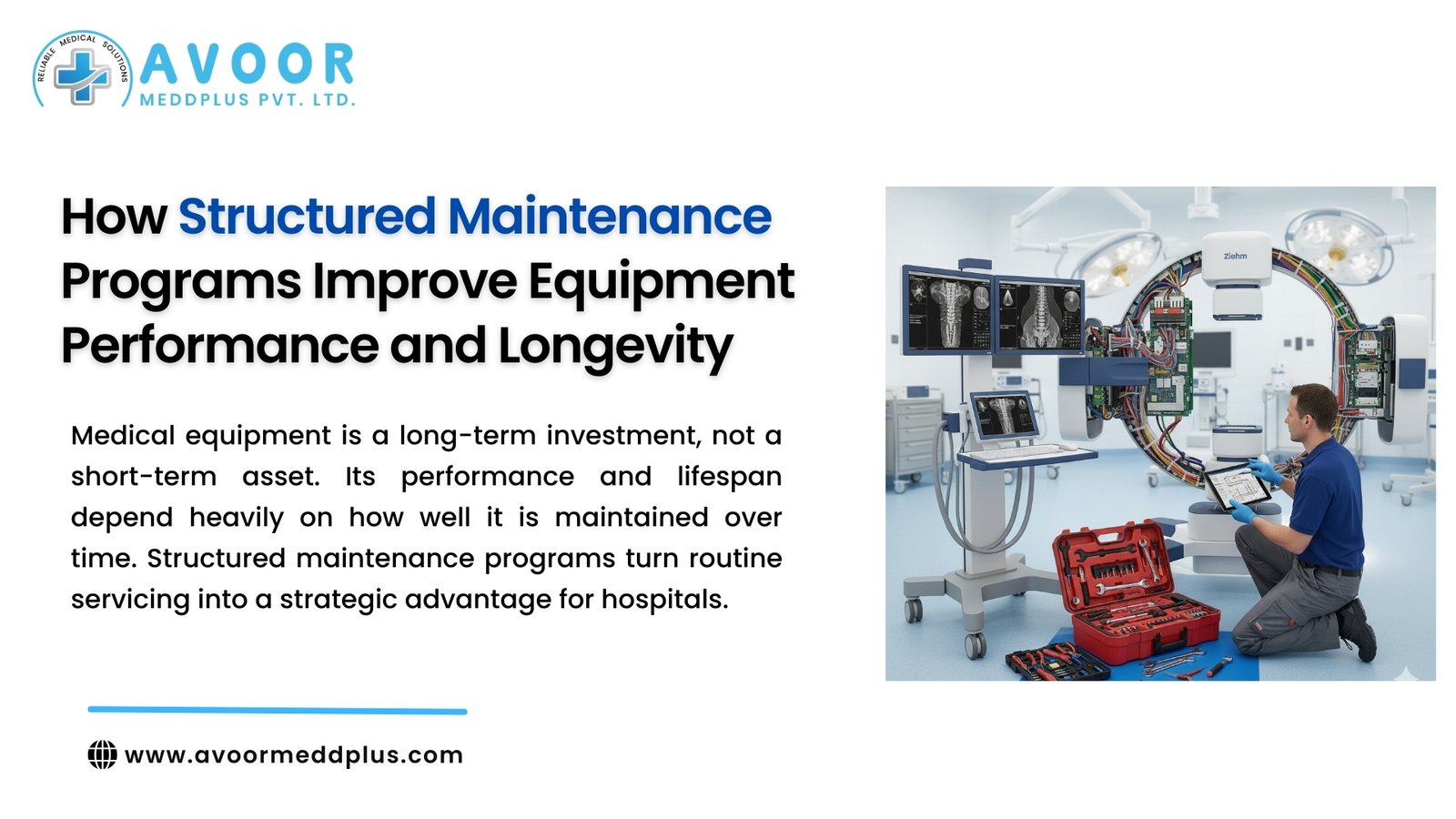
Introduction
Medical equipment is one of the most valuable investments for hospitals and diagnostic centers. From imaging systems like CT, PET/CT, DR, C-ARM, and SPECT/CT to critical biomedical devices, consistent performance is essential for accurate diagnosis, patient safety, and smooth clinical operations. However, Structured Maintenance Programs Equipment equipment performance and lifespan do not depend only on technology, they depend heavily on how the equipment is maintained.
This is why structured maintenance programs improve equipment performance and longevity more effectively than reactive or ad-hoc servicing. A structured approach ensures discipline, consistency, and predictability in maintenance activities. At Avoor Meddplus, structured maintenance programs Structured Maintenance Programs Equipment Performance Longevity 7 Proven Benefits for Hospitals are designed to protect performance, extend equipment life, and reduce operational risk for hospitals.
1. What Are Structured Maintenance Programs?
Structured maintenance programs are planned, documented, and repeatable maintenance frameworks. Instead of fixing equipment only after failure, these programs follow predefined schedules and procedures.
A structured maintenance program typically includes:
- Scheduled preventive maintenance
- Routine calibration and validation
- Safety inspections
- Performance trend monitoring
- Detailed service documentation
- Predictive fault identification
This systematic approach ensures equipment is maintained proactively rather than reactively.
2. Why Unstructured Maintenance Reduces Equipment Performance
Hospitals that rely on unplanned or reactive maintenance often face inconsistent equipment behavior. Small issues are overlooked until they escalate into major failures.
Unstructured maintenance leads to:
- Calibration drift
- Inconsistent image quality
- Frequent emergency breakdowns
- Higher repair costs
- Reduced equipment lifespan
In contrast, structured maintenance programs improve equipment performance and longevity by preventing these problems before they affect clinical operations.
3. How Structured Maintenance Programs Improve Equipment Performance
1️⃣ Consistent Calibration and Accuracy
Regular calibration is essential for maintaining diagnostic accuracy. Structured programs ensure calibration is performed at defined intervals, not skipped or delayed.
Benefits include:
- Stable image quality
- Accurate radiation output
- Reliable clinical interpretation
Consistent calibration directly improves day-to-day equipment performance.
2️⃣ Early Detection of Performance Drift
Structured maintenance programs include routine inspections and performance checks. These help identify early warning signs such as:
- Temperature irregularities
- Power instability
- Minor image artifacts
- Mechanical wear
Addressing these issues early prevents performance degradation and sudden failures.
3️⃣ Reduced Emergency Breakdowns
Because structured programs focus on prevention, emergency breakdowns become less frequent. Structured Maintenance Programs Equipment Performance Longevity 7 Proven Benefits for Hospitals Components are serviced or replaced before they fail completely.
This results in:
- Higher equipment uptime
- Fewer service interruptions
- More predictable clinical schedules
4. How Structured Maintenance Programs Extend Equipment Longevity
1️⃣ Reduced Stress on Critical Components
Equipment components such as tubes, detectors, power boards, and cooling systems experience stress over time. Structured maintenance ensures:
- Proper cooling and ventilation
- Stable electrical supply
- Mechanical alignment
Reduced stress significantly extends component lifespan.
2️⃣ Prevention of Cascading Failures
When small faults are ignored, they often damage surrounding components. Structured maintenance programs prevent cascading failures by fixing issues at an early stage.
This protects the overall system and reduces the need for major replacements.
3️⃣ Optimized Use of Spare Parts
Planned maintenance allows hospitals to replace parts strategically rather than during emergencies. Structured Maintenance Programs Equipment Performance Longevity 7 Proven Benefits for Hospitals This leads to:
- Better spare planning
- Lower replacement costs
- Fewer urgent procurement delays
5. 7 Key Benefits of Structured Maintenance Programs
1️⃣ Improved Equipment Reliability
Routine checks and validations ensure equipment performs consistently every day.
2️⃣ Extended Equipment Lifespan
Regular maintenance slows wear and delays costly equipment replacement.
3️⃣ Lower Long-Term Maintenance Costs
Preventive care costs far less than emergency repairs and repeated failures.
4️⃣ Better Diagnostic Accuracy
Stable performance leads to accurate imaging and clinical confidence.
5️⃣ Reduced Downtime
Planned service minimizes unexpected breakdowns.
6️⃣ Improved Regulatory Compliance
Structured documentation supports audits and accreditation.
7️⃣ Predictable Maintenance Planning
Hospitals gain better control over budgets, schedules, and resource allocation.
6. Structured Maintenance Across Imaging Modalities
Structured maintenance programs are tailored to each modality:
CT & PET/CT
- Gantry alignment
- Detector calibration
- Tube and cooling system checks
- Dose accuracy verification
DR & CR
- Flat-panel detector calibration
- Exposure linearity testing
- Image uniformity checks
C-ARM
- Fluoroscopy output accuracy
- Radiation dose control
- Mechanical and electrical safety
SPECT/CT & Nuclear Medicine
- Energy peaking
- Uniformity correction
- Fusion alignment accuracy
Each modality benefits from a structured, repeatable maintenance framework.Structured Maintenance Programs Equipment Performance Longevity 7 Proven Benefits for Hospitals.
7. Role of Biomedical Engineers in Structured Maintenance
Certified biomedical engineers are the backbone of structured maintenance programs. Their expertise enables them to:
- Follow standardized service protocols
- Identify early performance deviations
- Perform precise calibration and safety checks
- Maintain accurate service records
Without skilled engineers, maintenance programs lose their effectiveness.
8. How Avoor Meddplus Implements Structured Maintenance Programs
Avoor Meddplus delivers structured maintenance programs through:
- Scheduled preventive maintenance plans
- OEM-grade calibration and validation
- Performance trend monitoring
- PCB-level repair expertise
- Early fault detection
- Compliance-ready documentation
- Nationwide service consistency
This disciplined approach ensures measurable improvement in both equipment performance and longevity.
Conclusion
Medical equipment performance and lifespan are not determined by technology alone—they are shaped by maintenance discipline. Structured maintenance programs improve equipment performance and longevity by ensuring consistency, early fault detection, and proactive care.
Hospitals that invest in structured maintenance gain higher uptime, better diagnostic accuracy, lower long-term costs, and extended equipment life. With experienced partners like Avoor Meddplus, structured maintenance becomes a strategic advantage rather than a routine obligation—supporting reliable healthcare delivery every day.