
Introduction
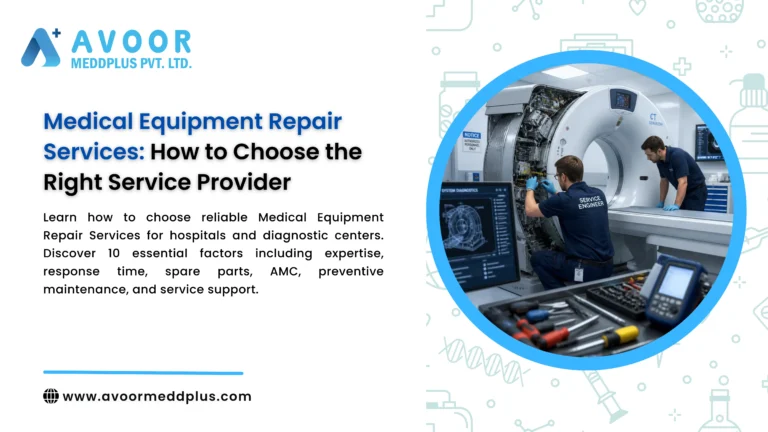
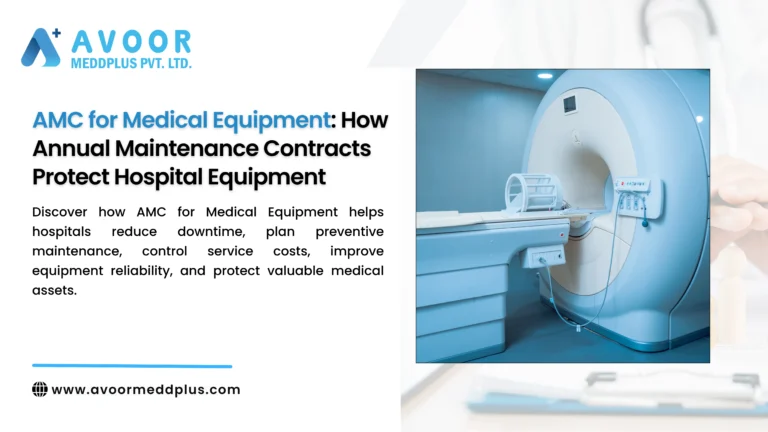
Hospitals today operate in a highly demanding environment where patient safety, operational efficiency, and financial sustainability must coexist. Medical imaging and critical biomedical equipment such as CT, PET/CT, DR, C-ARM, SPECT/CT, and nuclear medicine systems form the backbone of diagnosis and treatment. When these systems fail unexpectedly, the impact is immediate and costly.
This is why preventive maintenance strategic investment hospitals increasingly prioritize is no longer viewed as an expense, but as a long-term business and clinical strategy. Preventive maintenance protects equipment performance, controls costs, ensures compliance, and supports uninterrupted patient care. At Avoor Meddplus, preventive maintenance is delivered as a structured, value-driven program designed to strengthen hospital operations.
1. Preventive Maintenance Is No Longer Optional for Hospitals
In the past, many hospitals relied on reactive maintenance fixing equipment only after it failed. Today, this approach is risky and inefficient. Modern imaging systems are complex, software-driven, and highly sensitive to environmental and calibration changes.
Preventive maintenance allows hospitals to:
- Detect problems early
- Maintain consistent equipment performance
- Avoid sudden system shutdowns
- Reduce clinical disruption
Hospitals that treat preventive maintenance as a strategic investment gain control over both risk and reliability.
2. The True Cost of Equipment Downtime
Imaging downtime is one of the most expensive operational risks in a hospital. When equipment goes offline, hospitals face:
- Cancelled or delayed patient appointments
- Diagnostic backlogs
- Idle clinical staff
- Emergency repair costs
- Revenue loss
- Reduced patient satisfaction
Preventive maintenance strategic investment hospitals rely on helps minimize these losses by stabilizing equipment availability and performance.
3. Preventive Maintenance Protects Diagnostic Accuracy
Equipment that is not maintained regularly may continue operating while silently drifting out of specification. Calibration errors, detector instability, and software misalignment can degrade image quality without immediate failure.
Preventive maintenance ensures:
- Accurate calibration
- Stable radiation output
- Consistent image quality
- Reliable clinical results
By protecting diagnostic accuracy, preventive maintenance directly supports better patient outcomes and clinician confidence.
4. 7 Critical Reasons Preventive Maintenance Is a Strategic Investment
1️⃣ Reduces Unplanned Breakdowns
Preventive maintenance identifies wear, overheating, power irregularities, and early component failure before they cause system shutdowns.
2️⃣ Extends Equipment Lifespan
Imaging systems are major capital investments. Regular preventive care reduces stress on tubes, detectors, power boards, and cooling systems, extending usable life.
3️⃣ Controls Long-Term Maintenance Costs
Planned maintenance is significantly less expensive than emergency repairs. Hospitals benefit from predictable costs and fewer major component replacements.
4️⃣ Improves Clinical Workflow Efficiency
Scheduled maintenance avoids sudden interruptions, allowing hospitals to manage imaging schedules smoothly and efficiently.
6️⃣ Reduces Repeat Repairs and Service Calls
Early intervention prevents cascading failures, reducing repeated service visits and ongoing disruption.
7️⃣ Strengthens Long-Term Vendor Partnerships
Hospitals that invest in preventive maintenance develop stronger relationships with service partners who understand their equipment history and operational needs.
5. Preventive Maintenance vs Reactive Maintenance
| Aspect | Preventive Maintenance | Reactive Maintenance |
|---|---|---|
| Downtime | Minimal and planned | Sudden and prolonged |
| Cost | Predictable | High and unpredictable |
| Safety | Proactively managed | Risk-prone |
| Image Quality | Consistent | Variable |
| Equipment Life | Extended | Reduced |
This comparison clearly shows why preventive maintenance strategic investment hospitals choose delivers measurable returns.
6. Preventive Maintenance Across Imaging Modalities
Preventive maintenance strategies are tailored for each modality:
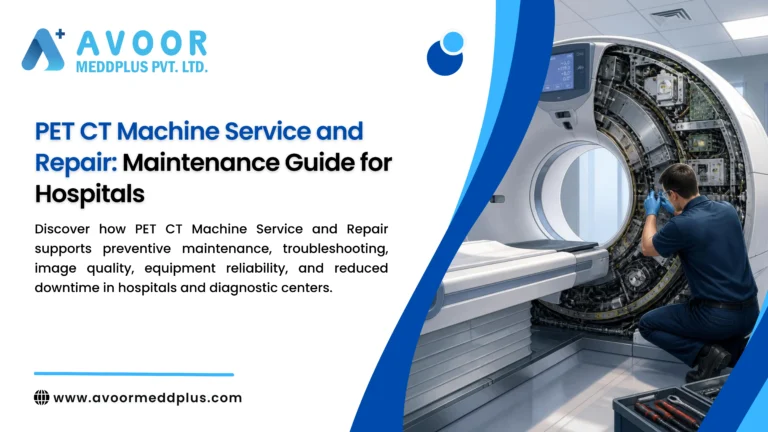
CT & PET/CT Systems
- Gantry alignment
- Detector calibration
- Tube and cooling checks
- Dose accuracy verification
DR & CR Systems
- Flat-panel detector calibration
- Exposure linearity testing
- Image uniformity checks
C-ARM Systems
- Fluoroscopy output accuracy
- Radiation dose control
- Mechanical and electrical safety
SPECT/CT & Nuclear Medicine
- Energy peaking
- Uniformity correction
- Fusion alignment accuracy
Each system requires specialized preventive care to maintain reliability.
7. Role of Biomedical Engineers in Preventive Maintenance
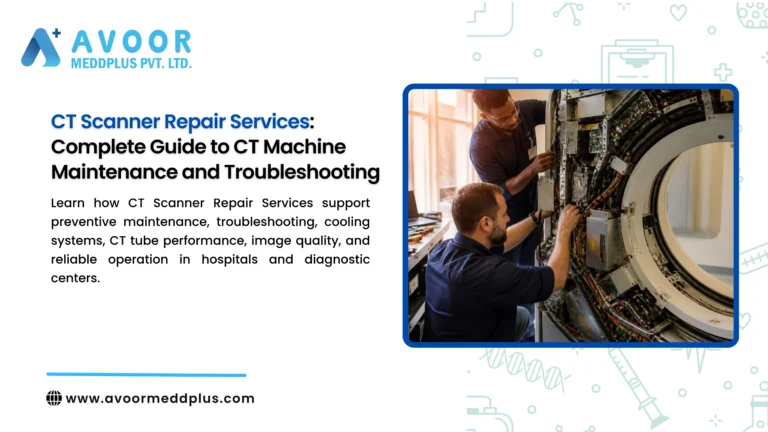
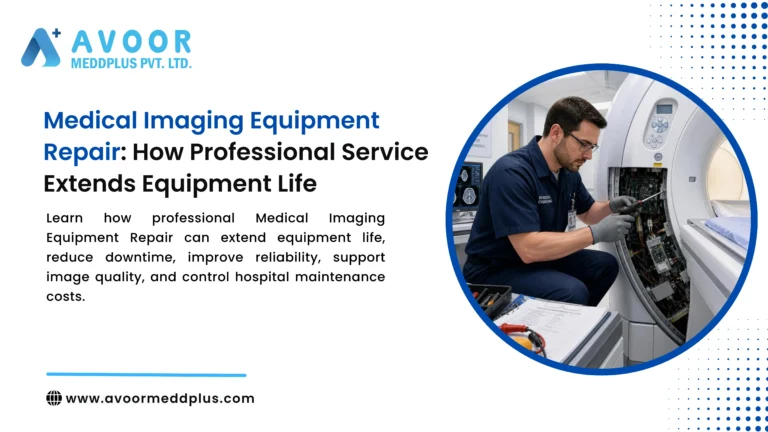
Certified biomedical engineers are central to preventive maintenance success. Their expertise allows them to:
- Identify early warning signs
- Perform precise calibration
- Ensure electrical and radiation safety
- Maintain accurate service documentation
Hospitals rely on skilled engineers to ensure preventive maintenance delivers real value, not just routine checklists.
8. How Avoor Meddplus Helps Hospitals Maximize ROI
Avoor Meddplus supports hospitals with preventive maintenance programs that include:
- OEM-grade calibration and validation
- Scheduled preventive maintenance visits
- Early fault detection and predictive analysis
- PCB-level repair expertise
- Fast-response corrective support
- Compliance-ready documentation
- Nationwide service coverage
This structured approach transforms preventive maintenance into a strategic investment rather than a maintenance expense.
Conclusion
Healthcare equipment reliability is not achieved by chance, it is built through planning, discipline, and expertise. Preventive maintenance strategic investment hospitals prioritize delivers reduced downtime, controlled costs, improved diagnostic accuracy, and stronger compliance.
By investing in preventive maintenance and partnering with experienced service providers like Avoor Meddplus, hospitals protect their equipment, their clinicians, and most importantly, their patients. Preventive maintenance is not just about maintaining machines—it is about sustaining healthcare delivery itself.