
Introduction
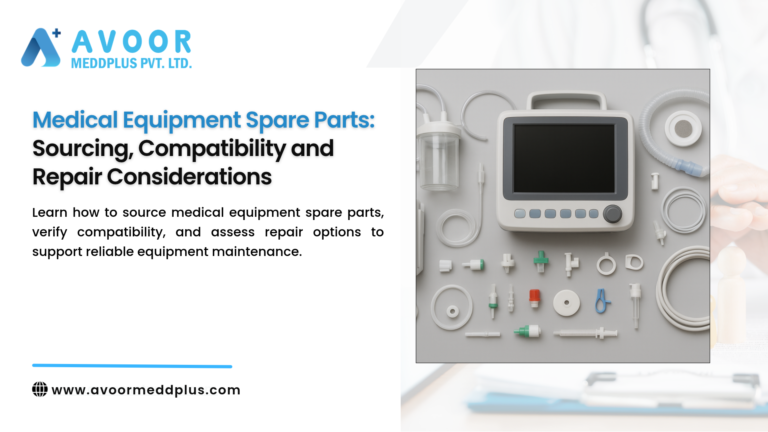
Medical Equipment Spare Parts play an important role in maintaining the reliability and availability of healthcare technology. Hospitals, diagnostic centers, and medical service teams depend on suitable replacement components to restore equipment, complete maintenance, and reduce avoidable service interruptions.
However, selecting a spare part is not simply a matter of finding a component with a similar appearance or specification. The correct part must be suitable for the equipment model, configuration, and intended function. Incorrect or unsuitable parts can lead to installation problems, recurring faults, equipment damage, or safety and performance concerns.
A well-managed spare-parts process includes accurate identification, supplier evaluation, compatibility verification, repair assessment, and documentation. This guide explains how healthcare facilities can make informed decisions when sourcing, repairing, or replacing medical equipment components.
Table of Contents
- What Are Medical Equipment Spare Parts?
- Why Correct Spare Parts Matter
- Common Types of Medical Equipment Spare Parts
- How to Source Medical Equipment Spare Parts
- How to Verify Compatibility
- Repair or Replace: How to Decide
- Risks of Incorrect or Unverified Parts
- Spare-Parts Inventory Planning
- Maintenance and Documentation Best Practices
- How to Choose a Spare-Parts Service Provider
- Frequently Asked Questions
- Why Choose Avoor Meddplus Pvt Ltd?
- Conclusion
What Are Medical Equipment Spare Parts?
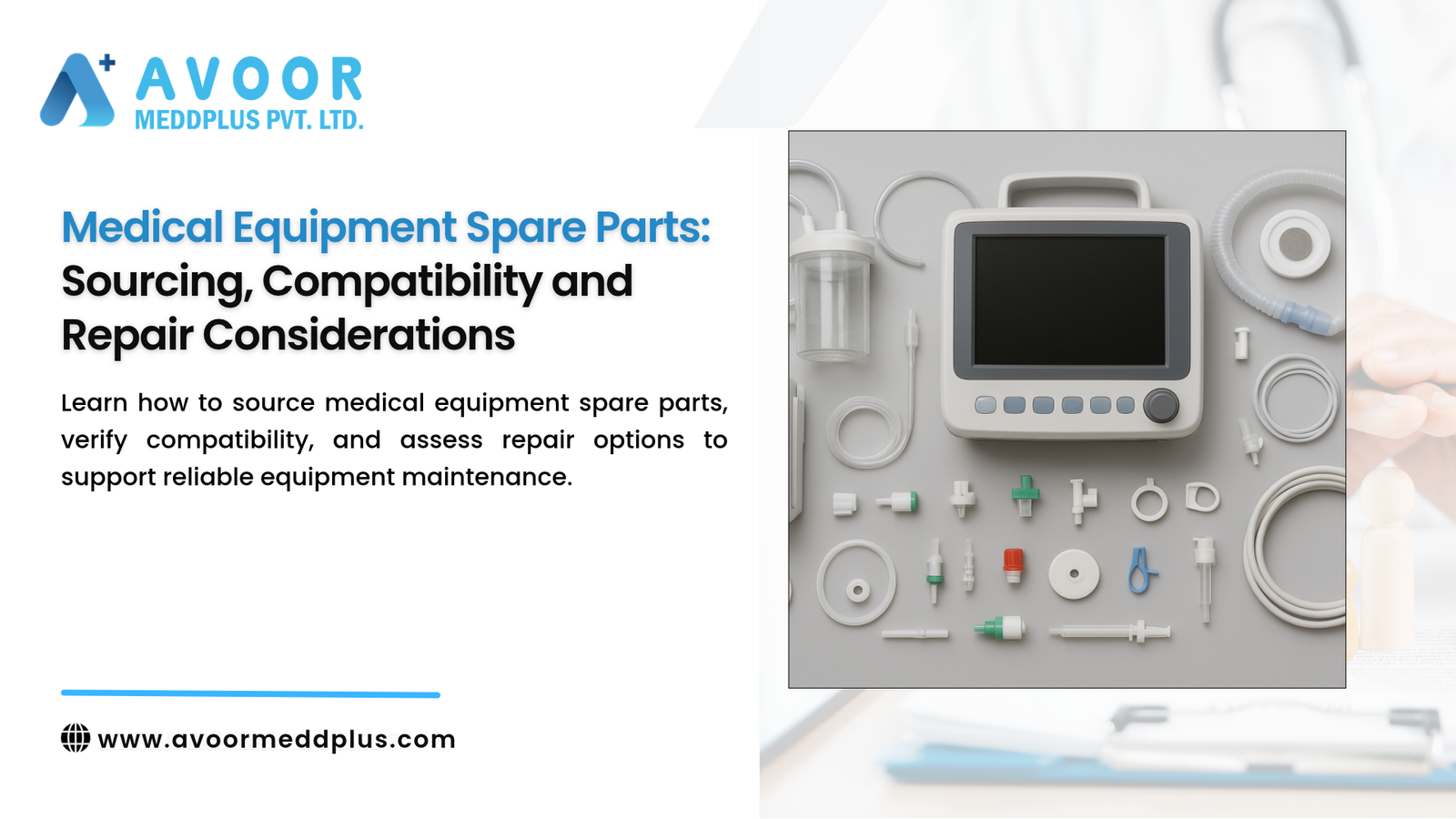
Medical Equipment Spare Parts are components used to maintain, repair, or restore medical devices and healthcare equipment.
Depending on the equipment, parts may be mechanical, electrical, electronic, software-related, or specific to an imaging system. They may be replaced during planned maintenance or following a breakdown.
Examples include:
- Power-supply modules
- Electronic boards and control assemblies
- Cables and connectors
- Fans and cooling components
- Sensors and switches
- Motors and mechanical assemblies
- Detector-related components
- System-specific accessories
- Approved consumables and replaceable items
The correct part depends on the equipment manufacturer, model, configuration, revision, and service requirements.
Why Correct Spare Parts Matter
Selecting an appropriate component supports more than simply getting a machine running again.
Equipment Reliability
A compatible, suitable part helps the system operate as intended. Incorrect components may cause intermittent faults or additional failures.
Patient and Staff Safety
Medical equipment must meet the applicable safety and performance requirements. Parts affecting safety-critical functions require particular care and must be assessed by qualified personnel.
Reduced Downtime
Accurate part identification can reduce delays caused by ordering the wrong component or repeating repair work.
Better Cost Control
A well-informed repair or replacement decision can help avoid unnecessary spending on unsuitable parts or repeated service visits.
Service Traceability
Recording part details and service actions helps maintain a clear history of equipment maintenance and repair.
Common Types of Medical Equipment Spare Parts
The components required vary by equipment type and manufacturer.
Electrical and Electronic Components
These may include power modules, control boards, circuit boards, relays, cables, and connectors. Their suitability depends on the equipment design and electrical specifications.
Mechanical Components
Mechanical parts may include motors, bearings, movement assemblies, locks, and positioning components. Compatibility includes physical fit and functional performance.
Cooling Components
Fans, pumps, filters, and other cooling-related parts may be important for equipment that requires controlled thermal conditions.
Imaging-System Components
CT, MRI, X-ray, PET/CT, SPECT/CT, mammography, and ultrasound systems use specialized components. A part that is suitable for one system may not be suitable for another, even within the same product family.
Accessories and Replaceable Items
Accessories and consumables should be checked against the equipment’s approved specifications and intended use.
How to Source Medical Equipment Spare Parts
Sourcing begins with identifying the exact component and confirming the requirements for the repair.
1. Identify the Equipment Accurately
Record the information available on the equipment label and service documentation, such as:
- Manufacturer
- Equipment model
- Serial number, where appropriate
- Part number
- Part revision or version
- Configuration details
- Reported fault
- Previous replacement history
Do not rely only on a visual resemblance or a general product description.
2. Check the Part Number
A part number is often one of the most useful ways to identify a component. However, the number should be checked against the correct equipment model and configuration.
If a part number has changed or been superseded, confirm that the proposed replacement is approved for the specific system.
3. Evaluate the Supplier
Consider whether the supplier can provide:
- Clear part identification
- Traceable sourcing information
- Condition details
- Relevant documentation
- Warranty or return terms
- Technical support for compatibility questions
Supplier claims should be verified where the component is safety- or performance-critical.
4. Confirm the Part’s Condition
Ask whether the part is new, refurbished, repaired, or used. The condition should be clearly stated and appropriate for the intended application.
For critical components, confirm what inspection, testing, or documentation accompanies the part.
5. Review Availability and Lead Time
A low-cost component may not be the best choice if sourcing delays create prolonged equipment downtime. Compare availability, delivery estimates, warranty terms, and the total cost of the repair.
6. Keep Procurement Records
Maintain records of the supplier, part number, condition, purchase details, and any documentation provided. This supports traceability and future maintenance planning.
How to Verify Medical Equipment Spare Parts Compatibility
Compatibility should be confirmed before a component is installed.
Model and Configuration
Check that the part is suitable for the exact equipment model and configuration. Similar model names do not guarantee interchangeability.
Part Number and Revision
Verify the complete part number and any relevant revision or version information. If a replacement part is listed as a substitute, confirm that the substitution applies to the specific system.
Electrical and Functional Specifications
Where applicable, qualified personnel should verify relevant electrical, mechanical, and functional specifications using approved documentation.
Software or Firmware Requirements
Some components may require specific software, firmware, configuration, or service procedures. Confirm these requirements before installation.
Manufacturer Guidance
Use manufacturer documentation and approved service information wherever available. Do not assume a component is compatible solely because it fits physically.
Post-Installation Verification
After installation, complete the required operational, safety, and quality-control checks according to the equipment’s service requirements and facility procedures.
Important: Do not install a part when its suitability is uncertain, particularly if it affects radiation production, patient positioning, image acquisition, electrical safety, or another safety-critical function.
Repair or Replace: How to Decide
Not every faulty component needs to be replaced, and not every component is suitable for repair. The decision should be based on technical evaluation and the equipment’s requirements.
| Consideration | Repair May Be Considered | Replacement May Be Preferable |
|---|---|---|
| Fault type | The fault is diagnosable and repairable | The component is severely damaged |
| Part availability | Replacement is difficult to source | A suitable replacement is available |
| Cost | Repair is economically reasonable | Repair cost is excessive |
| Reliability | Testing can establish acceptable function | Future reliability is uncertain |
| Safety | Repair can follow approved procedures | Safety or performance cannot be assured |
| Documentation | Repair and testing can be recorded | Required traceability is unavailable |
For safety-critical or highly specialized components, follow manufacturer requirements and seek qualified technical advice. A cost comparison alone is not enough to establish that a repair is appropriate.
Risks of Incorrect or Unverified Spare Parts
Using an unsuitable or poorly documented component can create technical and operational risks.
Equipment Damage
A part with incorrect specifications may affect other components or cause additional failures.
Repeated Breakdowns
A component that does not address the underlying fault may result in recurring service calls and extended downtime.
Performance Problems
An incompatible part may affect equipment operation or image quality.
Safety Concerns
Components involved in electrical protection, radiation-related functions, patient positioning, or other safety-critical operations require particular attention.
Traceability Gaps
Unclear sourcing or missing documentation can make it difficult to determine what was installed and whether the repair was properly verified.
For these reasons, avoid selecting parts solely on price or appearance.
Spare-Parts Inventory Planning
A planned inventory can help healthcare facilities reduce delays when commonly needed parts are unavailable.
Identify Critical Components
Use equipment history, service recommendations, component lead times, and operational importance to identify parts that may need priority planning.
Review Equipment Age and Support Status
Older equipment may have longer sourcing times or limited parts availability. Plan accordingly, while checking the suitability of any proposed replacement.
Track Usage and Failure History
Record which parts are frequently replaced and which failures cause the longest interruptions.
Set Stock Levels Carefully
Avoid both excessive inventory and insufficient stock. Inventory decisions should reflect actual equipment needs, storage requirements, part availability, and budget.
Review Inventory Regularly
Check stock condition, documentation, storage requirements, and whether parts remain suitable for the equipment they are intended to support.
Maintenance and Documentation Best Practices
A reliable spare-parts process should be supported by clear records.
For each repair or replacement, document:
- Equipment identification
- Reported fault
- Part number and revision
- Supplier and part condition
- Diagnosis and repair decision
- Work performed
- Test results
- Recommendations
- Date of service
- Responsible service personnel
Keep records in line with facility procedures and applicable requirements. Clear documentation helps identify recurring problems and supports future repair decisions.
How to Choose a Medical Equipment Spare-Parts Service Provider
Technical Knowledge
Choose a provider that understands the relevant equipment type and can help verify part suitability.
Transparent Sourcing
Ask for clear information about the part number, condition, source, and available documentation.
Compatibility Support
The provider should be able to explain how compatibility is established for the specific equipment model and configuration.
Repair Evaluation
A capable service provider should assess whether repair or replacement is appropriate rather than automatically recommending the most expensive option.
Testing and Documentation
Confirm what testing and service documentation will be provided after installation or repair.
Clear Commercial Terms
Review pricing, lead time, warranty, return conditions, and any exclusions before placing an order.
Why Choose Avoor Meddplus Pvt Ltd?
Avoor Meddplus Pvt Ltd provides medical imaging equipment maintenance and repair support for healthcare facilities.
Service capabilities may include:
- Medical imaging equipment troubleshooting
- Preventive and breakdown maintenance
- Electronic diagnostics
- PCB and component-level repair, where appropriate
- Power-supply troubleshooting
- Spare-parts support
- Repair and replacement assessment
- Maintenance documentation
- AMC support
Service scope depends on the equipment model, fault, parts availability, and agreed service terms.
Conclusion
Medical Equipment Spare Parts are an important part of reliable equipment maintenance. Correct identification, compatibility verification, supplier evaluation, and clear documentation can help healthcare facilities avoid unsuitable components and unnecessary repair delays.
Before ordering or installing a part, confirm the equipment model, part number, revision, condition, and applicable service requirements. For complex or safety-critical components, rely on qualified personnel and equipment-specific procedures.
A structured spare-parts strategy can support more informed repair decisions, better maintenance planning, and dependable healthcare equipment operation.