Introduction
Medical equipment repair is not just a technical activity, it is a responsibility that directly impacts patient safety, diagnostic accuracy, and clinical outcomes. When imaging and biomedical equipment fail, hospitals depend on repair services to restore performance quickly and correctly. Quality Assurance Medical Equipment Repair Services, However, without strict quality checks, a repaired system may function temporarily while hiding deeper risks.
This is why quality assurance in medical equipment repair services is critical. Quality assurance (QA) ensures that every repair is performed correctly, validated thoroughly, and documented transparently. At Avoor Meddplus, quality assurance is embedded into every repair process to ensure safety, compliance, and long-term reliability.
1. What Is Quality Assurance in Medical Equipment Repair?
Quality assurance in repair services refers to a structured process that verifies whether repaired equipment meets predefined safety, performance, and regulatory standards.
QA in medical equipment repair typically includes:
- Correct fault identification
- OEM-grade repair procedures
- Post-repair calibration and testing
- Safety validation (electrical and radiation)
- Documentation and traceability
Without QA, repairs become trial-and-error activities that expose hospitals to risk.
2. Why Repair Quality Directly Impacts Patient Safety
Medical equipment influences clinical decisions every day. Poor-quality repairs can lead to:
- Incorrect diagnostic results
- Increased radiation exposure
- Unstable system behavior
- Repeat scans and delayed treatment
For example, a CT or C-ARM system that is repaired without proper calibration may still power on but deliver inaccurate images or unsafe dose levels. Quality assurance prevents such hidden failures by validating equipment performance before it returns to clinical use.
3. 5 Critical Reasons Quality Assurance Is Essential in Repair Services
1️⃣ Ensures Repairs Restore OEM-Level Performance
Quality assurance verifies that repaired equipment performs at manufacturer-specified levels. This includes:
- Image quality consistency
- Correct radiation output
- Stable detector response
- Reliable mechanical operation
OEM-grade restoration is impossible without structured QA checks.
2️⃣ Prevents Repeat Failures and Downtime
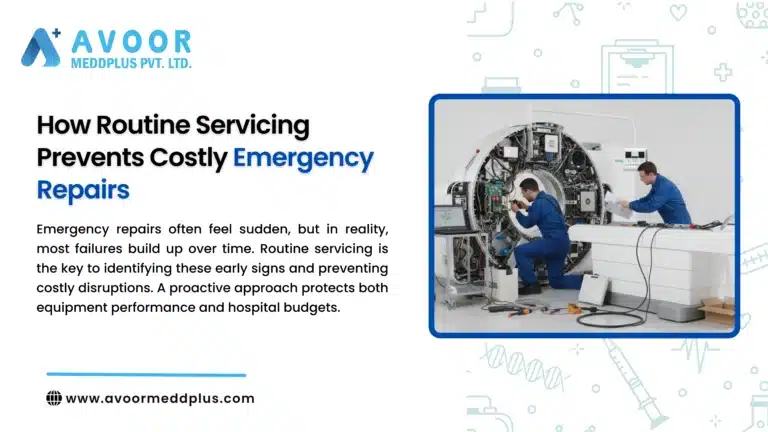
One of the biggest risks of poor repair quality is recurrence. When root causes are not properly identified or validated, the same failure returns.
QA ensures:
- Root-cause analysis is completed
- Repairs address the actual issue, not symptoms
- Post-repair testing confirms stability
This significantly reduces repeat breakdowns and emergency service calls.
3️⃣ Supports Regulatory and Safety Compliance
Medical equipment repair must comply with safety regulations and accreditation standards. Quality assurance ensures that:
- Radiation safety limits are verified
- Electrical safety tests are completed
- Calibration records are maintained
- Preventive maintenance history is traceable
QA protects hospitals during audits and inspections by ensuring every repair is compliant.
4️⃣ Builds Trust Between Hospitals and Service Providers
Hospitals rely on repair partners they can trust. Quality assurance builds that trust by providing:
- Transparent service reports
- Calibration certificates
- Test results and validation data
- Clear explanation of work performed
When hospitals see documented proof of quality, confidence in the service provider increases.
5️⃣ Protects Long-Term Equipment Health
Poor repairs can damage other components over time. QA ensures that:
- Correct parts are used
- Component-level issues are addressed
- System balance and alignment are maintained
This protects equipment lifespan and reduces long-term maintenance costs.
4. Quality Assurance vs Basic Repair: The Difference
| Aspect | Basic Repair | QA-Driven Repair |
|---|---|---|
| Fault handling | Symptom-based | Root-cause based |
| Testing | Minimal | Comprehensive |
| Calibration | Often skipped | Mandatory |
| Safety validation | Inconsistent | Standardized |
| Documentation | Limited | Complete & traceable |
| Reliability | Unpredictable | Consistent |
Hospitals that prioritize QA-driven repair experience fewer failures and higher uptime.
5. Role of Calibration in Quality Assurance
Calibration is a core component of quality assurance. After repair, calibration ensures:
- Accurate imaging output
- Correct radiation dose levels
- Alignment between hardware and software
- Consistent system performance
QA frameworks treat calibration as non-negotiable, especially for CT, PET/CT, DR, C-ARM, and nuclear medicine systems.
6. Quality Assurance Across Imaging Modalities
Quality assurance applies across all equipment types:
CT & PET/CT
- Detector and gantry calibration
- Dose accuracy verification
- Image reconstruction validation
DR & CR
- Flat-panel detector uniformity
- Exposure linearity testing
- Image quality checks
C-ARM
- Fluoroscopy brightness consistency
- Radiation safety validation
- Mechanical stability testing
SPECT/CT & Nuclear Medicine
- Energy peaking
- Uniformity correction
- Fusion alignment accuracy
Each modality requires tailored QA procedures to ensure safe operation.
7. Role of Biomedical Engineers in QA-Driven Repair
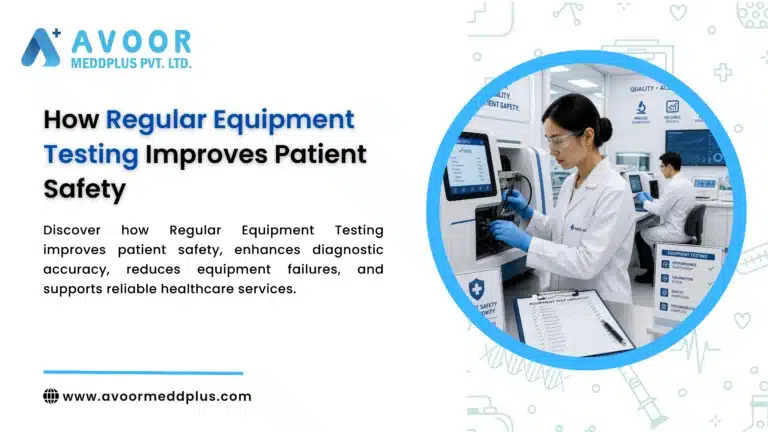
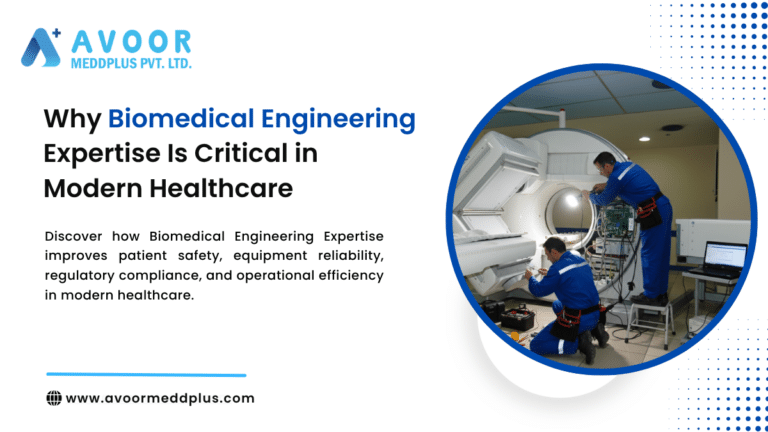
Certified biomedical engineers are central to quality assurance. Their responsibilities include:
- Following standardized repair protocols
- Performing safety and performance tests
- Verifying calibration accuracy
- Maintaining detailed documentation
QA is effective only when engineers are trained, disciplined, and compliance-focused.
8. How Avoor Meddplus Implements Quality Assurance in Repairs
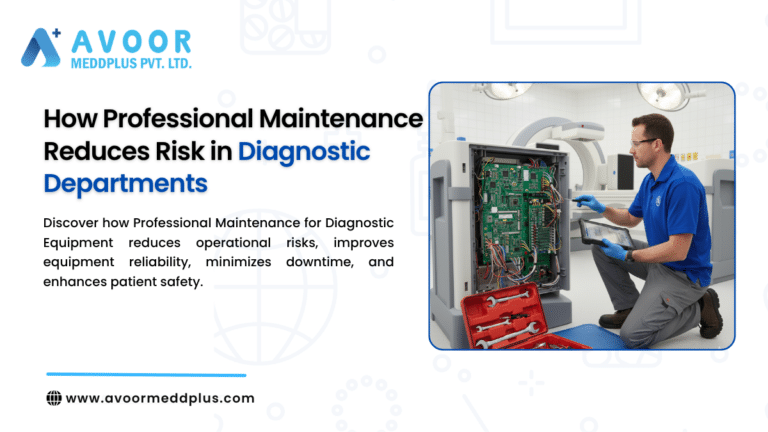
Avoor Meddplus ensures QA-driven repair services through:
- OEM-grade diagnostic and repair procedures
- PCB-level repair expertise
- Mandatory post-repair calibration
- Radiation and electrical safety testing
- Detailed service and compliance reports
- Preventive maintenance integration
- Nationwide service consistency
Every repair is validated not just for functionality, but for safety and long-term reliability.
Conclusion
In medical equipment repair, quality cannot be assumed—it must be verified. Quality assurance in medical equipment repair services ensures that repaired systems are safe, accurate, compliant, and dependable.
Hospitals that choose QA-driven repair partners reduce downtime, avoid repeat failures, protect patient safety, and maintain clinical confidence. Through disciplined processes, transparent documentation, and strict compliance, Avoor Meddplus delivers repair services that hospitals can trust—every time.