
Introduction
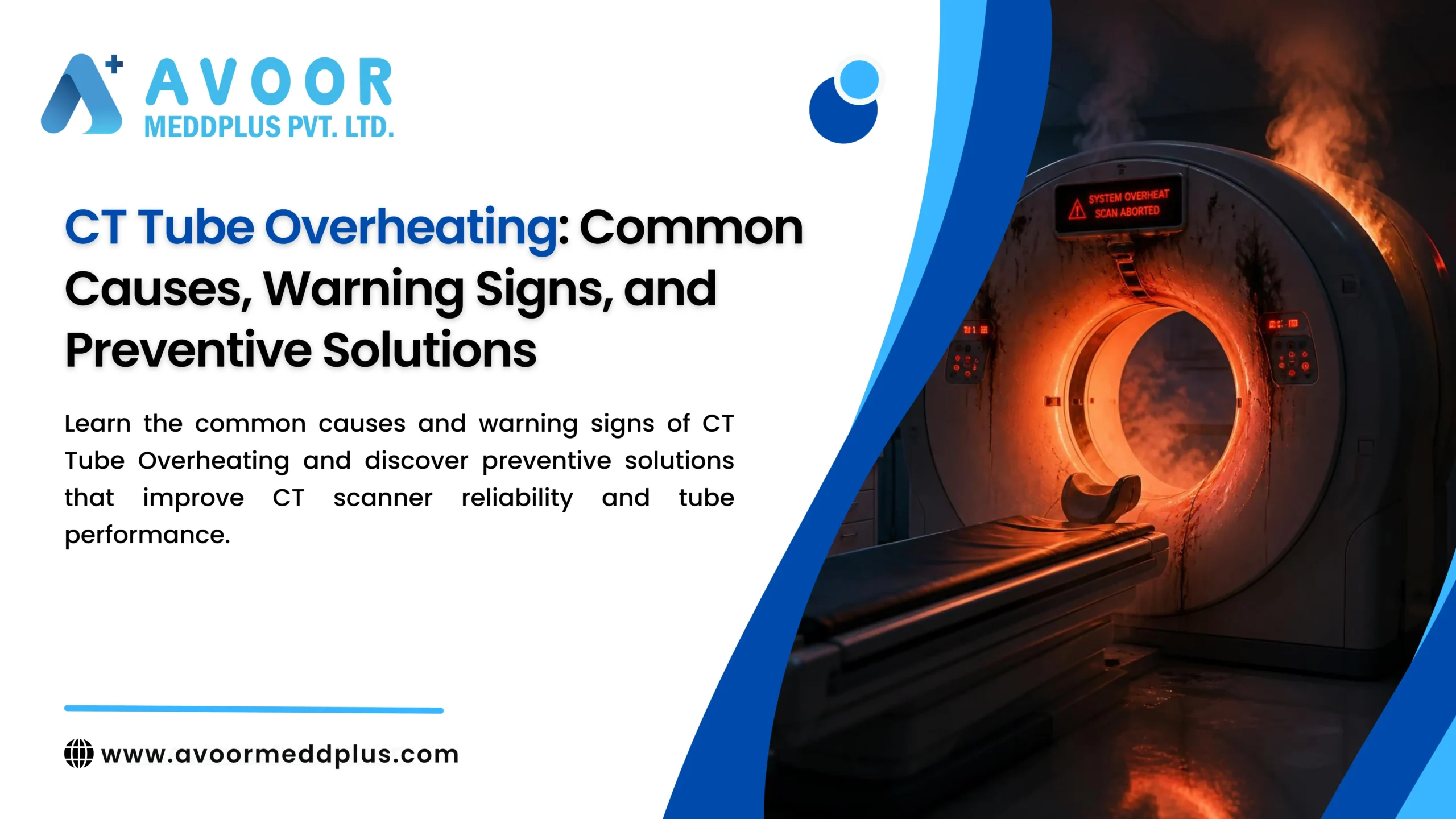
CT Tube Overheating is an important operational concern in computed tomography systems, particularly in facilities with demanding scanning schedules. A CT scanner‘s X-ray tube generates substantial heat during image acquisition, and that heat must be effectively managed by the tube and the scanner’s cooling systems.
Modern CT systems are designed with heat-management mechanisms, monitoring systems, and protective controls. However, demanding scan workloads, cooling problems, environmental conditions, component degradation, or equipment faults can contribute to elevated thermal stress.
Repeated CT Tube Overheating warnings should not simply be ignored or continuously reset. Persistent thermal problems can interrupt scanning schedules, increase equipment downtime, affect component reliability, and potentially contribute to expensive corrective repairs.
Understanding the causes and early warning signs can help hospitals and diagnostic centers implement appropriate preventive maintenance and protect one of the most important components in a CT scanner.
What Is CT Tube Overheating?
Understanding CT Tube Overheating
A CT tube produces X-rays by accelerating electrons toward a target inside the tube assembly. Only part of the energy involved contributes to useful X-ray production, while a substantial amount is converted into heat.
The CT system must manage this thermal load effectively.
CT Tube Overheating occurs when thermal conditions approach or exceed the operating limits monitored by the system, or when heat cannot be dissipated as effectively as expected.
Modern CT scanners may monitor factors such as:
- Tube thermal load
- Scan workload
- Cooling performance
- System temperatures
- Tube operating conditions
- Environmental temperature
- Protective thresholds
Depending on the scanner, the system may display warnings, restrict scanning, introduce cooling delays, or stop certain operations to protect the equipment.
Why Does a CT Tube Generate Heat?
Every CT examination requires the X-ray tube to produce radiation while rotating rapidly around the patient.
During demanding scanning sessions, the tube may operate repeatedly at substantial electrical loads.
Heat generation is influenced by factors including:
- Tube current
- Tube voltage
- Scan duration
- Scan protocol
- Number of consecutive examinations
- Patient requirements
- System design
- Tube specifications
The scanner’s heat-management system is designed to dissipate this energy between and during examinations.
Problems arise when heat generation consistently exceeds the system’s ability to remove it efficiently.
Common Causes of CT Tube Overheating
1. Continuous High-Volume Scanning
One of the most common contributors to thermal stress is a demanding patient workload with limited recovery time between high-load examinations.
Busy diagnostic centers may perform many scans throughout the day.
The thermal impact depends not simply on patient count but also on:
- Examination type
- Scan protocol
- Tube current
- Tube voltage
- Scan duration
- Number of acquisitions
- Tube and scanner design
Facilities should therefore follow manufacturer-recommended operating and cooling guidance rather than relying on a universal number of scans between breaks.
2. High-Demand Scan Protocols
Some protocols place greater thermal demands on the X-ray tube than others.
Higher exposure settings or extended acquisitions can generate additional heat.
Repeated high-demand studies may increase thermal loading and cause the scanner to require additional cooling time.
Protocol optimization should always be performed by appropriately qualified clinical and technical personnel.
3. Cooling System Problems
The CT tube and scanner depend on effective cooling.
Potential problems include:
- Cooling fan failure
- Restricted airflow
- Blocked filters
- Heat exchanger problems
- Cooling unit malfunction
- Temperature sensor problems
- Cooling circuit faults
If the cooling system cannot dissipate heat efficiently, thermal warnings may occur more frequently.
4. Poor Room Ventilation or HVAC Performance
CT scanners operate within environmental specifications established by their manufacturers.
Excessive room temperature or inadequate HVAC performance can make it more difficult for the scanner to dissipate heat.
Healthcare facilities should monitor equipment-room conditions and maintain them within the required operating range.
5. Dust and Restricted Airflow
Dust accumulation can restrict airflow through:
- Air filters
- Cooling vents
- Fans
- Heat exchangers
- Electronic cabinets
Routine preventive maintenance and approved cleaning procedures can help maintain proper airflow.
6. Aging CT Tube
CT tubes are high-stress components with finite operating lives.
As a tube and associated components age, facilities may notice changes in performance or an increasing frequency of faults.
Tube condition should be evaluated using the scanner’s service information, operating history, error logs, and appropriate technical diagnostics.
7. Cooling Component Degradation
Fans, pumps, sensors, and other cooling components may deteriorate over time.
A scanner that previously handled a particular workload without difficulty but begins generating frequent thermal warnings may require technical inspection.
10 Warning Signs of CT Tube Overheating
1. Repeated Temperature Warning Messages
Repeated temperature or cooling warnings are among the clearest signs that thermal conditions require investigation.
The exact message varies by CT manufacturer and model.
2. Scanner Requests Additional Cooling Time
Some systems automatically prevent or delay further scanning while thermal conditions recover.
Occasional system-managed cooling may be normal under demanding workloads. A significant change in frequency, however, should be investigated.
3. Unexpected Scan Interruptions
If examinations repeatedly stop because of thermal or related system conditions, a qualified CT engineer should inspect the equipment.
4. Longer Recovery Between Scans
A noticeable increase in required cooling or recovery time compared with the system’s normal performance may indicate changing thermal conditions.
5. Cooling System Alarms
Warnings involving fans, cooling units, airflow, sensors, or related systems require prompt attention.
6. Unusual Noise from Cooling Components
Abnormal fan, pump, or cooling-system noises can indicate mechanical wear or component problems.
7. Increasing Frequency of Tube-Related Errors
Recurring tube-related errors should be reviewed using the manufacturer’s technical documentation and scanner service logs.
8. Abnormal Image Performance
Not every image artifact is caused by a tube problem. However, if changes in image quality occur alongside tube or thermal warnings, the system should be evaluated before assumptions are made about the cause.
9. Scanner Shutdowns
Protective shutdowns can occur when a system detects conditions that may threaten safe or reliable operation.
Repeated shutdowns require professional diagnosis.
10. Visible Leakage or Physical Abnormalities
Any visible fluid or oil-like leakage, unusual smell, smoke, or other physical abnormality around imaging equipment should be treated seriously.
Operators should follow facility safety procedures and manufacturer guidance rather than attempting to open or repair the tube assembly.
How CT Tube Overheating Can Affect Equipment Reliability
Persistent thermal stress can affect more than daily scanning productivity.
Potential consequences include:
Reduced Equipment Availability
Cooling delays and thermal shutdowns can interrupt patient schedules.
Increased Downtime
A developing cooling or tube problem may eventually result in equipment becoming unavailable for clinical use.
Higher Maintenance Costs
Failure to correct an underlying thermal issue can contribute to additional service requirements.
Patient Scheduling Problems
Unexpected downtime can lead to:
- Cancelled scans
- Rescheduled appointments
- Longer waiting times
- Reduced department productivity
Potential Component Stress
Repeated operation under adverse thermal conditions may place additional stress on components.
Because CT tubes are high-value assemblies, preventive maintenance is considerably more desirable than waiting for a serious failure.
Preventive Solutions for CT Tube Overheating
1. Follow Manufacturer Operating Guidelines
Every CT scanner and tube combination has specific operating characteristics.
Healthcare facilities should follow manufacturer guidance for:
- Thermal management
- Scan protocols
- Environmental conditions
- Preventive maintenance
- System operation
Avoid applying a fixed cooldown rule from one CT model to another.
2. Monitor Scanner Workload
High-volume facilities should monitor scanner utilization and identify periods of unusually demanding workloads.
Scheduling can be managed where clinically practical to reduce unnecessary thermal stress.
3. Maintain the Cooling System
Preventive maintenance should include inspection of applicable cooling components, such as:
- Fans
- Filters
- Vents
- Heat exchangers
- Cooling circuits
- Temperature sensors
Cooling-system maintenance is essential for reliable CT operation.
4. Maintain Proper Room Temperature
The CT room and equipment areas should remain within the environmental specifications provided by the equipment manufacturer.
HVAC systems should be maintained to provide stable environmental conditions.
5. Keep Airflow Paths Clean
Dust and blocked ventilation can reduce cooling efficiency.
Filters and ventilation areas should be inspected and maintained according to approved procedures.
6. Perform Regular Preventive Maintenance
Scheduled CT Scanner Maintenance allows engineers to identify:
- Cooling problems
- Fan degradation
- Temperature abnormalities
- Power issues
- Tube-related errors
- Hardware faults
Early detection can prevent larger failures.
7. Review Error and Service Logs
Modern CT systems maintain valuable diagnostic information.
Qualified engineers can analyze:
- Error history
- Temperature-related events
- Tube warnings
- Cooling faults
- System shutdown events
Patterns in these logs can help identify the root cause of recurring overheating.
8. Investigate Changes in System Behavior
If a scanner suddenly requires more cooling time than before, do not assume that it is simply caused by workload.
A change in behavior can indicate a developing technical problem.
When Should You Call a CT Service Engineer?
Professional technical support should be requested when:
- CT Tube Overheating warnings repeatedly occur
- Cooling alarms appear frequently
- Scanner recovery time increases significantly
- The system unexpectedly shuts down
- Fan or cooling-system errors appear
- Tube-related faults become frequent
- Image quality changes alongside system warnings
- Abnormal sounds are present
- Fluid or oil-like leakage is observed
- Normal scanning operations are repeatedly interrupted
A qualified CT engineer can review system logs, inspect cooling components, perform technical diagnostics, and determine whether the problem originates from the tube, cooling system, electronics, environment, or another subsystem.
Why Choose Avoor Meddplus Pvt Ltd?
Avoor Meddplus Pvt Ltd provides professional repair, maintenance, installation, and technical support for medical imaging equipment.
Our CT scanner service capabilities include:
- CT Scanner Repair
- CT Tube Technical Support
- Preventive Maintenance
- Cooling System Inspection
- System Error Diagnosis
- Hardware Troubleshooting
- PCB Repair
- Spare Parts Support
- AMC Services
- CAMC Services
- Per-Call Technical Support
- Installation Support
Our technical approach focuses on identifying the root cause of equipment problems rather than repeatedly clearing warning messages.
For hospitals and diagnostic centers experiencing CT tube warnings, cooling faults, scanner downtime, or recurring errors, professional diagnosis can help protect equipment reliability and clinical productivity.
Frequently Asked Questions
What causes CT Tube Overheating?
CT Tube Overheating can be associated with demanding scan workloads, high-load protocols, inadequate cooling, restricted airflow, environmental conditions, aging components, or technical faults.
Is CT tube heating normal?
Yes. CT tubes naturally generate substantial heat during X-ray production. CT systems are designed to manage this heat. Persistent overheating warnings or unusual changes in cooling behavior require investigation.
How long should a CT tube cool between scans?
There is no universal cooling interval applicable to every CT scanner. Cooling requirements depend on the manufacturer, tube model, protocol, thermal load, and system design. Follow the applicable manufacturer guidance and system indicators.
Can continuous scanning cause CT Tube Overheating?
A demanding sequence of examinations can increase thermal load. Whether it produces an overheating condition depends on the protocols, tube design, cooling system, and operating environment.
Can a cooling fan cause CT overheating?
Yes. Failed or degraded cooling components can reduce heat dissipation and contribute to thermal warnings.
Can CT Tube Overheating damage the tube?
Persistent adverse thermal conditions can place additional stress on equipment. The scanner’s protective systems are designed to manage thermal limits, but repeated overheating warnings should be investigated rather than ignored.
What should I do if my CT scanner shows an overheating warning?
Follow the manufacturer’s operator guidance and facility procedures. Record the warning and operating conditions. If the warning repeatedly returns or affects normal operation, contact a qualified CT service engineer.
Should I continue scanning when a CT tube temperature warning appears?
Follow the scanner’s instructions, manufacturer documentation, and your facility’s operating procedures. Do not bypass protective controls or override safety-related warnings.
Conclusion
CT Tube Overheating should never be treated as just another warning message, especially when it repeatedly occurs.
CT systems are designed to manage significant thermal loads, but excessive workload, cooling-system problems, restricted airflow, environmental conditions, aging components, and technical faults can affect heat management.
The most effective approach is preventive.
Regular CT scanner maintenance, proper cooling-system inspection, workload monitoring, stable environmental conditions, error-log analysis, and timely professional service can help hospitals and diagnostic centers minimize unexpected downtime and protect valuable equipment.
If your CT scanner is experiencing repeated overheating warnings, extended cooling delays, tube-related errors, abnormal noises, or unexpected shutdowns, Avoor Meddplus Pvt Ltd can provide professional CT scanner diagnostics, repair, maintenance, and technical support.
Need CT Scanner Technical Support?
Contact Avoor Meddplus Pvt Ltd for:
- CT Scanner Repair
- CT Tube Support
- Preventive Maintenance
- CT Scanner AMC & CAMC
- Cooling System Troubleshooting
- PCB Repair
- Spare Parts Support
- Per-Call Service